

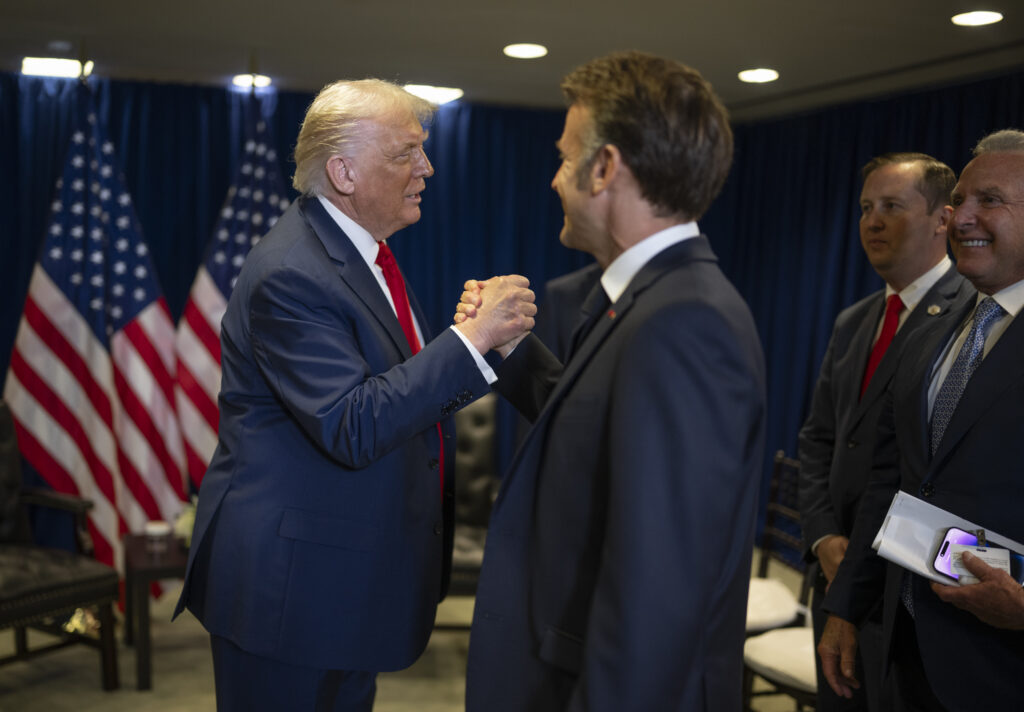
DAVOS, Switzerland — French President Emmanuel Macron delivered unusually sharp criticism of President Donald Trump on Tuesday, using a speech at the World Economic Forum to frame Europe as a stabilizing force in contrast to what he described as growing U.S. aggressiveness.
The remarks, aimed at both defending the European Union and rebuking Washington, underscored a widening rift between longtime Western allies — one Macron suggested could mark the most serious strain in transatlantic relations in generations.
Europe as a “Predictable” Power
Speaking to business and political leaders in Davos, Macron acknowledged Europe’s shortcomings but portrayed the continent as fundamentally reliable and law-bound.
Europe, he said, is “sometimes too slow, for sure, and needs to be reformed, sure,” but remains “predictable, loyal, and where you know that the rules of the game are just the rule of law.” Despite its flaws, Macron called Europe “a good place, for today and tomorrow.”
He contrasted that vision with a pointed critique of what he sees as coercive tactics elsewhere.
“We do believe that we need more growth, we need more stability in this world,” Macron said. “But we do prefer respect over bullies, and we do prefer rule of law over brutality.”
He closed the segment with an open invitation: “You’re welcome in Europe, and you are more than welcome to France.”
Greenland Dispute and Tariff Threats
Macron reserved his sharpest remarks for proposed punitive tariffs linked to Trump administration demands for “Complete and Total Control of Greenland,” which is administered by Denmark and hosts a U.S. military presence.
The French leader called the idea “crazy” and warned that the European Union could, for the first time, deploy its anti-coercion instrument against the United States — a move designed to counter economic pressure from foreign powers.
“I do regret that,” Macron said, “but this is a consequence of just unpredictability and useless aggressivity,” referring directly to Trump.
"It's clear we are reaching a time of instability."
— Bloomberg (@business) January 20, 2026
French President Emmanuel Macron says US tariffs are "unacceptable," especially when used as political leverage https://t.co/ccfNCPbXBs pic.twitter.com/XqYXUdlvWk
As the BBC reports, European Commission President Ursula von der Leyen echoed that stance, vowing an “unflinching” response to defend EU members and partners such as Denmark if U.S. pressure escalates:
In her speech in Davos speech, Ursula von der Leyen reached back in time for examples of how Europe had prospered in the wake of instability trigged by a previous US administration.
She argued that here in 2026 an independent Europe was vital to survive the current seismic geopolitical changes.
But the reason EU leaders have not been more forceful in their response to President Trump’s Greenland tariff threat is that they are still hugely dependent on US military power and need its support for Ukrainian security as well as that of the wider continent.
That is why European leaders want face time with Donald Trump to try to assess what he really wants to do, rather than try to decipher from afar his cluster of latest social media broadsides.
Russian Foreign Minister Sergey Lavrov also weighed in Tuesday, saying he could understand why the United States might want Greenland.
Lavrov compared the Danish territory to Crimea — Ukrainian land that Russia annexed in 2014 — a move seen as a precursor to Moscow’s full-scale invasion of Ukraine.
Trade, NATO and Arctic Tensions
The prospect of the EU using its anti-coercion mechanism against Washington would mark a significant escalation in trade disputes and could further strain NATO unity, particularly as Arctic strategic interests grow more contested.
Macron has increasingly positioned Europe as an independent pole in global politics, and Tuesday’s remarks made that contrast explicit — framing the EU as a rules-based actor while accusing the U.S. of bullying behavior.
Trump appears to have leaked a private text message from Emmanuel Macron.
— MeidasTouch (@MeidasTouch) January 20, 2026
Why would any leader ever trust someone who leaks their private conversations? pic.twitter.com/vgg9fvZcaE
The tone suggests a shift from private frustration to open confrontation, even as security cooperation within NATO remains formally intact.
U.S. Response Urges Calm
Speaking separately in Davos, U.S. Treasury Secretary Scott Bessent sought to tamp down tensions, urging European leaders to “relax” and “let things play out.”
That message may be hard to maintain. Criticism of Washington’s approach is now coming from both liberal and conservative leaders across NATO, suggesting that concerns over U.S. unpredictability are no longer limited to left-leaning voices overseas.
'We're going to get beyond this little rift.'
— GB News (@GBNEWS) January 19, 2026
Speaker of the United States House of Representatives, Mike Johnson says the differences between the US and the UK on Greenland are not a threat to the 'special relationship'. pic.twitter.com/cFu0KrtJV7
For now, the dispute over Greenland and tariffs appears to be a flashpoint — but one that reflects deeper questions about leadership, leverage and the future of the Western alliance.
BREAKING: President Trump posts a picture of map with Canada, Greenland, and Venezuela all part of the United States. pic.twitter.com/4yDc5vcDp3
— The Kobeissi Letter (@KobeissiLetter) January 20, 2026
READ NEXT: Rising Dem Star Unveils Dirty Accusation Against Team Kamala











We owe France a tremendous debt for their help in our revolutionary war and likewise they owe us a tremendous debt from WWII. MAcron is a wimpy little politician(liberal) who needs to be put in his place. Hope Trump treats him sternly in Davos.