

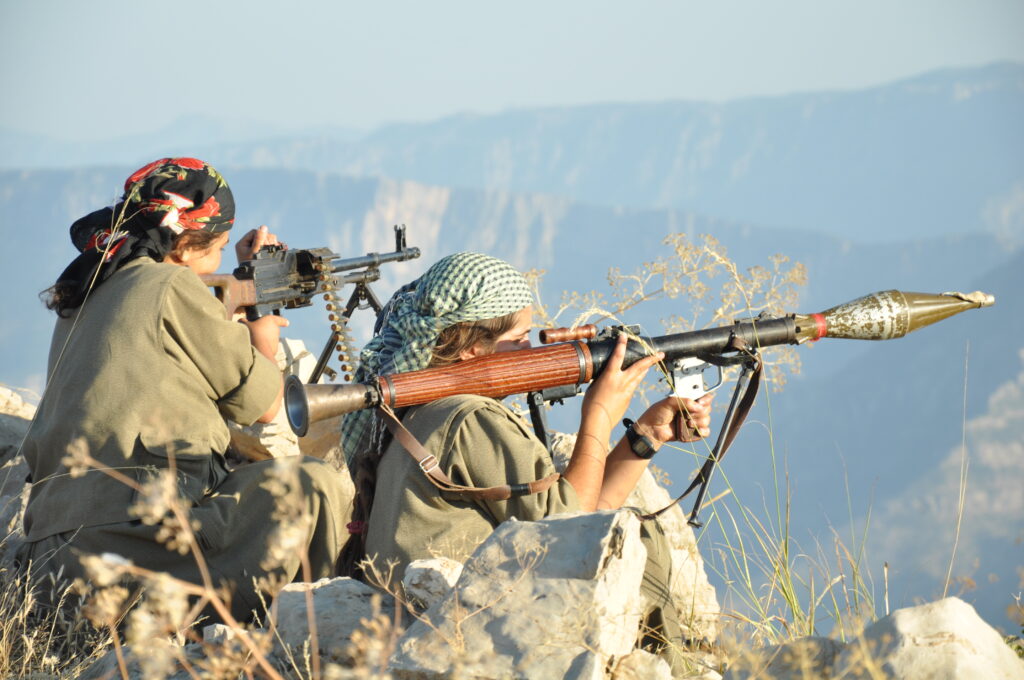
The White House is pushing back on reports that the CIA is preparing to arm Kurdish groups operating from northern Iraq, even as President Donald Trump has personally reached out to Kurdish leaders amid the escalating conflict with Iran.
Officials confirmed that Trump has spoken by phone with political figures in Iraqi Kurdistan as well as Kurdish opposition leaders from Iran. Those conversations focused on the broader war effort against Tehran and whether Kurdish forces could play a role in future operations.
But the administration says one claim circulating in media reports is simply not true.
“Any report suggesting the president agreed to such a plan is false,” White House Press Secretary Karoline Leavitt said, referring to allegations that the CIA had been authorized to supply weapons to Kurdish fighters.
Leavitt said Trump’s discussions with Kurdish leaders focused on U.S. military operations connected to American bases in northern Iraq and regional security issues.
As The Washington Post reports:
The CIA declined to comment. The White House did not respond to questions about contacts with other Iranian opposition groups, including the Baluchi minority or the exiled group Mojahedin-e-Khalq (MEK).
A U.S. official cautioned that the extent of Kurdish cooperation with the U.S. remains to be seen, given Washington’s long history of enlisting their aid in various conflicts and then abandoning them.
“Could there be some opportunities to work together and our interests to be aligned, and do some things? Absolutely,” the U.S. official said. But the Kurds on both sides of the Iraq-Iran border are likely to wait to see “which way the wind is blowing” in the ongoing war, he said, adding that U.S. cooperation with them is “not totally cut and dry.”
The Kurds, in Iran numbering about 10 million across five western provinces, are also among the largest minorities in Iraq, Syria and parts of Turkey. In each of those countries, they have fought politically and sometimes physically — often with U.S. support when it coincided with American objectives — against systematic marginalization and for the right to self-determination.
However, The Post added that many Kurdish partners feel increasingly marginalized by Washington as the United States shifts its Middle East strategy, including reducing support for the Kurdish-led Syrian Democratic Forces (SDF) to adapt to new political realities in Damascus.
Kurdish groups weighing involvement
Behind the scenes, several Iranian Kurdish opposition groups based in northern Iraq have been debating whether they should enter the conflict against the Iranian government.
Some of these organizations fought alongside U.S.-backed forces against ISIS and already maintain organized militias. Leaders from several factions have reportedly asked Washington for support if they move forward, including intelligence sharing, weapons, and the establishment of a no-fly zone over parts of western Iran.
For now, Kurdish officials appear cautious.
Leaders in Iraq’s Kurdistan region have expressed concern that open participation in the war could trigger Iranian retaliation. There is also uncertainty about how far the United States is willing to go if Kurdish forces launch cross-border operations.
That hesitation reflects the stakes. Any Kurdish involvement could rapidly broaden the conflict beyond the current air campaign being carried out by the United States and Israel against the Iranian leadership and military infrastructure.
New footage from U.S. Central Command (CENTCOM) showing strikes against Iranian forces across Iran, as Operation Epic Fury continues. pic.twitter.com/yLuQRhbSh1
— OSINTdefender (@sentdefender) March 5, 2026
Video footage has now been released of the moment the IRIS Shahid Sayyad Shirazi, a Soleimani-class corvette serving with Iran’s Islamic Revolutionary Guard Corps Navy (IRGCN), was targeted today by a U.S. strike off the coast of Bandar Abbas. Immediately following the strike,… pic.twitter.com/IHoLlCbx1J
— OSINTdefender (@sentdefender) March 5, 2026
Why Kurdish forces matter
Strategically, Kurdish fighters represent one of the few opposition forces with the organization and geography to challenge Tehran militarily.
The Kurdistan Region of Iraq shares roughly a 310-mile border with Iran. Much of that frontier runs through rugged mountains that have historically served as corridors for insurgent movements. Fighters familiar with the terrain could potentially move across the border and conduct guerrilla-style operations in western Iran.
Several established Kurdish factions already maintain armed forces. Among them are the Democratic Party of Iranian Kurdistan (KDPI), Komala, the Kurdistan Freedom Party (PAK) and PJAK.
Many of these groups have thousands of fighters and longstanding bases in Iraqi Kurdistan. Some also worked alongside U.S. forces during the campaign against ISIS, giving them combat experience and existing relationships with Western militaries.
This video feels like a scene straight out of a Hollywood movie but it's 100% real. These are authentic combat shots captured right on the battlefield by Kurdish Peshmerga forces fighting ISIS in 2014. pic.twitter.com/0AuO8W0d00
— Kurds on X (@kurdX_) March 2, 2026
Inside Iran itself, Kurdish-majority provinces such as Kurdistan, Kermanshah, and West Azerbaijan have long histories of unrest and separatist movements. Analysts say cross-border activity by Kurdish fighters could potentially trigger wider instability inside those regions.
A possible hybrid strategy
Military analysts have discussed the possibility of a hybrid approach similar to past U.S. campaigns in the Middle East.
Under that model, Kurdish fighters would handle ground operations while Western forces provide air power, intelligence, and logistical support. Kurdish units know the terrain and local networks. U.S. and allied aircraft could strike Iranian missile sites, military bases, and Islamic Revolutionary Guard Corps units.
A campaign built around that combination could open a western front against Tehran, forcing Iranian forces to defend a long mountainous border while also responding to attacks elsewhere.
Iran is already under pressure from U.S.-Israeli strikes on regime targets, tensions at sea, and ongoing domestic unrest related to economic conditions.
WATCH: Apocalyptic scenes in Tehran.
— Clash Report (@clashreport) March 4, 2026
Non-stop U.S.-Israeli airstrikes. pic.twitter.com/upMQc3GaEx
Periscope footage of a US Navy Submarine torpedoing the Iranian Frigate Dena off the coast of Sri Lanka.
— OSINTtechnical (@Osinttechnical) March 4, 2026
The Mk. 48 Torpedo’s 650 pound warhead can be seen detonating under the Iranian Frigate’s stern. pic.twitter.com/DypnxA1Whd
A Kurdish insurgency would add another challenge.
Major regional risks
Despite the potential strategic value, the idea of supporting Kurdish fighters carries serious political risks.
Iraq’s central government has repeatedly pledged to prevent attacks on Iran launched from Iraqi territory. If Kurdish groups used bases in northern Iraq for cross-border operations, Baghdad could face pressure to intervene.
Turkey is another factor. Ankara strongly opposes Kurdish militant groups, particularly those linked to the Kurdistan Workers’ Party, or PKK. U.S. support for Kurdish forces could trigger diplomatic friction with a key NATO ally.
Iran has also demonstrated a willingness to respond militarily. In past crises, Tehran has launched missile and drone strikes on Kurdish opposition bases inside Iraq.
There is also a longer-term concern: many Kurdish factions ultimately seek autonomy or independence. Supporting them could reshape political dynamics across multiple countries in the region.
The bottom line
For now, the White House says there is no plan to arm Kurdish fighters.
Still, Trump’s direct outreach to Kurdish leaders highlights how seriously U.S. officials are weighing the role Kurdish forces could play if the conflict with Iran continues to expand.
Their strategic value is clear: geographic access to Iran’s western border, established militias with combat experience, and potential support networks inside the country.
But any move in that direction would carry major geopolitical consequences, from Iranian retaliation to tensions with Turkey and Iraq.
That reality helps explain why, even as conversations continue, the administration is publicly drawing a firm line on one point: there is no approved plan to put American weapons in Kurdish hands.
READ NEXT: Trump Makes One Request Prior To Issuing Texas Senate Endorsement















BECAUSE OF THE NON STOP INTERFERENCE I WOULD REMOVE ALL SECRET CLEARANCES FROM EVERY LIBERAL IN WASHINGTON