

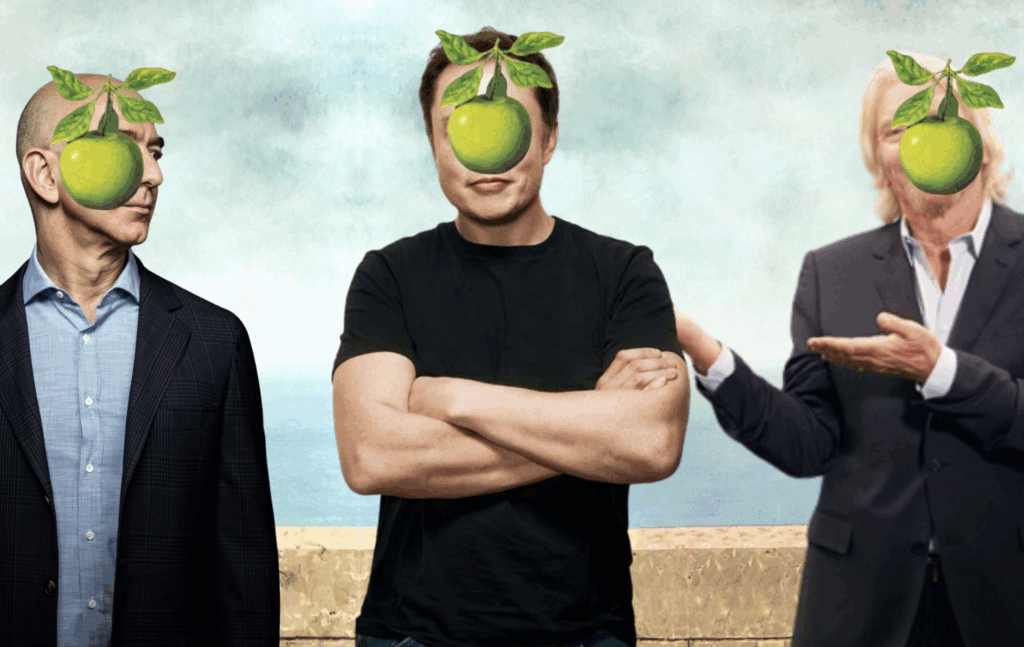
To say that Elon Musk or Jeff Bezos obsesses over marginal changes to their tax rate is akin to suggesting that Alexander the Great paused mid-campaign to haggle over the price of oats. The idea is not just incorrect, it is embarrassingly so. And yet, one hears it often. Every time legislation emerges that does not soak the rich with punitive fervor, a chorus of critics rises to declare that billionaires have manipulated the system once again, lining their pockets with taxpayer gold. The latest target is the so-called “Big Beautiful Bill,” which some on the Left have derided as a payoff to the ultra-wealthy.
But this claim rests on a fundamental misunderstanding of how billionaires think, live, and accumulate wealth. Once your net worth breaches the atmospheric heights of a billion dollars, taxes become noise. The signal, the thing that actually matters, is the health of the economy. More precisely, the well-being of the American middle class. For billionaires, prosperity is downstream from purchasing power. If the middle class thrives, they buy Teslas, subscribe to Amazon Prime, and make the economy hum. If they are squeezed, the entire machine sputters.
Consider Elon Musk. In 2021, Musk paid an eye-watering $10.7 billion in federal and state taxes, the largest single-year tax payment in American history. That sum, the GDP of a small nation, barely grazed his trajectory. He noted at the time, not with resentment but matter-of-fact candor, “I am the largest individual taxpayer in history.” He did not relocate to a tax haven. He did not seek refuge in Byzantine loopholes. Instead, he continued building: rockets, cars, batteries, neural interfaces. The tax did not slow him. He did not even flinch.
Why? Because Musk, like other billionaires, understands that real leverage does not come from trimming your personal tax bill. It comes from growing the economy. His wealth is tied to equity, not salary. Tesla stock, SpaceX valuation, and ventures like Starlink or xAI do not rise because he shields a few million from the IRS. They rise when GDP expands, when consumption grows, when millions of middle-class Americans have cash in hand and optimism in heart.
Billionaires are not driven by paycheck economics. They live in a post-tax reality where income is largely irrelevant. What matters is asset appreciation, and that only occurs when markets move. Thus, they are structurally aligned with pro-growth policy. Not because they are selfless, but because they are rational.
The irony is that those who most vocally demand that billionaires pay “their fair share” often craft policies that reduce the very economic vitality billionaires depend on. Higher capital gains taxes, for instance, disincentivize investment. Wealth taxes distort capital allocation. Punitive marginal rates drive entrepreneurs underground. In attempting to shackle the wealthy, these policies end up squeezing the economy’s throat.
What Musk and his peers want is quite different. They want the American economy to roar. They want the median household to have more disposable income, not because they harbor secret egalitarian dreams, but because they want to sell products and services to a thriving consumer base. As Steve Forbes once observed, “You cannot get rich in a poor country.” Indeed, you cannot remain rich in one either.
This logic is not new. It echoes Reaganite supply-side economics, which understood that broad-based prosperity benefits all. Critics scoffed then, as now, claiming trickle-down was a myth. But the evidence belied them. During the 1980s, real GDP grew, inflation fell, and the middle class expanded. Job creators and consumers alike prospered.
Even the Obama administration conceded as much, albeit in different language. In a 2012 speech, President Obama said, “Prosperity comes from an economy built on a strong and growing middle class.” Musk would agree. So would Bezos. So, for that matter, would Andrew Carnegie, who knew that accumulating wealth was meaningless if society at large remained impoverished. Philanthropy, in that vision, was not charity but strategy.
What Democrats misdiagnose as greed is often strategy. A billionaire who wants tax relief for the middle class is not acting against interest. He is acting precisely in alignment with it. If the average American keeps more of their paycheck, they buy more goods, invest more in their future, and raise children who become customers. The billionaire does not need a tax break on his marginal earnings. He needs a healthy, happy, hopeful America.
Let us return to Musk. His one-time $10.7 billion tax payment, driven by exercising Tesla stock options, had no noticeable impact on his net worth’s growth curve. Why? Because while the IRS collected billions, Tesla’s market cap surged. The real story was not the tax, but the explosion of wealth that dwarfed it. Musk’s net worth continued to climb because the economy did. His equity-based holdings far outpaced the tax drain. That is the nature of billionaire economics. They are not wage earners, they are asset holders. And assets, properly leveraged, grow at rates that render tax concerns marginal.
A 2021 ProPublica analysis found that the 25 richest Americans paid a “true tax rate” of just 3.4% on their wealth gains between 2014 and 2018. Critics seized on this as evidence of injustice. But they misunderstood the mechanism. The low rate was not due to evasion, but to structure. Billionaires do not realize income in the ordinary sense. They borrow, hold, defer, and pass. They live in what Edward McCaffery has called a “post-income” world. Raising the income tax rate, in this context, is like taxing fish for swimming.
Billionaires deploy capital through mechanisms the tax code barely touches. They fund foundations, create trusts, borrow against equity, and shelter gains in legal vehicles designed for stability. That is not corruption. That is the system. Changing the rates does little unless you change the structure. And even then, the unintended consequences could outweigh the gains.
Consider what happens when capital flees. France tried a wealth tax. It failed. Investors left. Revenues fell. The French economy stagnated. Growth cannot be coerced. It must be cultivated. Billionaires, for better or worse, are gardeners of capital. They plant where conditions are fertile. If America becomes hostile to growth, they will find other fields.
It is this macroeconomic awareness that shapes billionaire policy preferences. Not a desire for another yacht. Not a quest to buy a third island. But a cold calculation: which policies will let the economy grow fastest? Which will let my companies scale, my valuations rise, my equity multiply? The answer is almost always the same: policies that let ordinary people thrive.
This is why Musk and others advocate for tax relief directed not at themselves, but at the middle class. They want demand. They want consumers. A government that takes less from workers is one that gives more to markets. Musk would far rather you have an extra $5,000 in your bank account to buy a Tesla than save $5 million in taxes he will never spend.
In sum, while the Big Beautiful Bill is hardly beautiful, the notion that it is a giveaway to billionaires is not just wrong, it is inverted. It is a bet on growth, optimism, and expansion, an effort to catalyze consumer demand, not to line the pockets of the already wealthy. Billionaires will benefit, to be sure, but not from tax cuts. From GDP. From demand. From a humming economy that lifts all boats, including their own. Musk himself has expressed skepticism about the bill, not because it coddles billionaires, but because it risks ballooning the deficit to the breaking point. Trump, for his part, is betting that growth will outrun that risk. The wager is bold, but not incoherent. The bet is that a growing America is a solvent one.
To understand the billionaire mind is not to sympathize, but to clarify. It is not tax breaks that drive them. It is growth. And growth, historically, flows not from punishing success, but from enabling it. The Left may continue to demonize wealth, but it would do well to understand it first.
If you enjoy my work, please consider subscribing: https://x.com/amuse.
Sponsored by the John Milton Freedom Foundation, a nonprofit dedicated to helping independent journalists overcome formidable challenges in today’s media landscape and bring crucial stories to you.
READ NEXT: Peace With Ex-Terror Boss? Trump Leads, World Follows

















very educational. I appreciate your lesson.