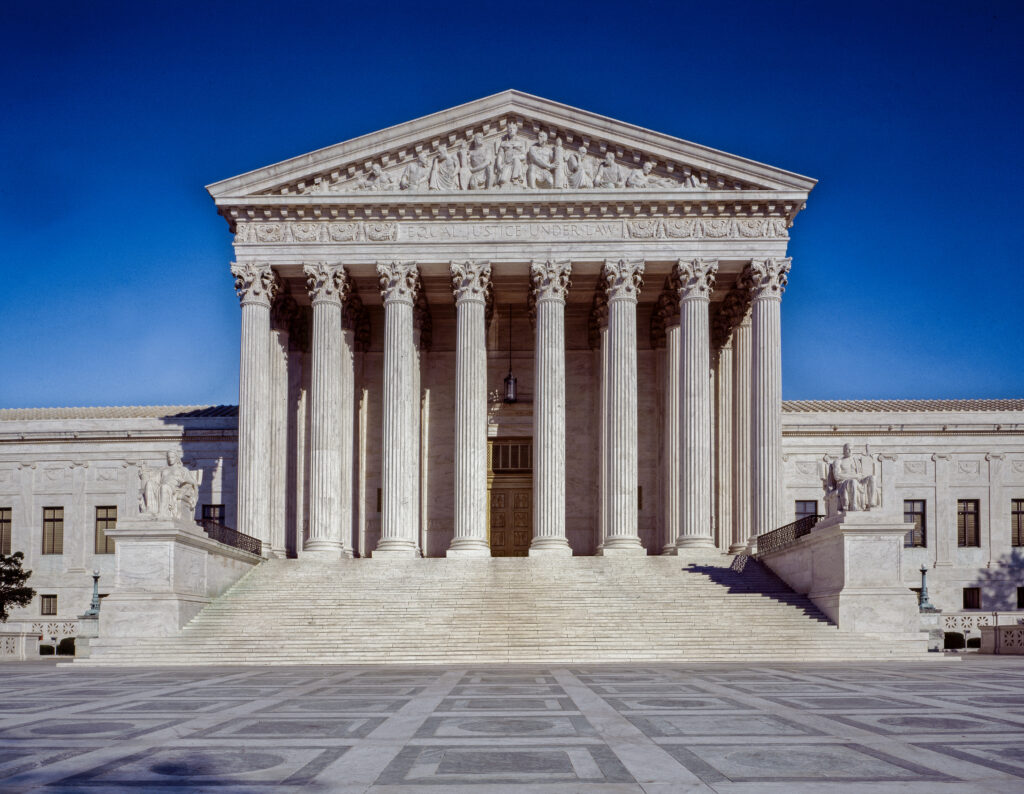
Alabama Republicans are once again asking the Supreme Court of the United States to intervene in the state’s ongoing congressional redistricting fight after a federal court blocked a GOP-backed map that would likely strengthen Republican chances ahead of the 2026 midterm elections.
The emergency request comes just one day after a three-judge federal panel ruled Alabama cannot use the proposed congressional map because the court found it intentionally discriminates against Black voters. (RELATED: Alabama Republicans Blocked From Reclaiming Key House Seat After Court Map Ruling)
The ruling keeps Alabama’s current court-ordered congressional map in place for now — the same map that created a second majority-Black or near-majority-Black district and helped Democrat Rep. Shomari Figures win election in 2024.
Alabama Republicans Push Supreme Court After Louisiana Decision
Alabama Attorney General Steve Marshall’s (R) office argued in a Supreme Court filing Wednesday that the justices’ recent 6-3 ruling involving Louisiana and the Voting Rights Act changed the legal landscape enough to justify reinstating Alabama’s preferred congressional map. (RELATED: Louisiana Lawmakers Advance Map Eliminating Democrat House District)
Republicans contend the newer legal standard allows states greater flexibility to pursue political and policy objectives during redistricting without automatically violating federal protections for minority voters.
“Alabama, no different than Louisiana, may stick to its neutral political and policy goals. That’s not intentional racial discrimination,” Marshall’s office wrote in the Supreme Court filing.
Marshall asked the Supreme Court to either allow Alabama Republicans to immediately use the proposed map or temporarily pause the lower court’s ruling while the justices review the case.
The emergency appeal now goes first to Justice Clarence Thomas, who handles emergency matters arising from Alabama. Thomas could act alone or refer the request to the full court, which is common in high-profile election disputes.
Federal Court Says Map Remains Constitutionally Problematic
The legal battle stems from Alabama Republicans’ attempt to redraw congressional boundaries after the Supreme Court previously ruled the state’s earlier map — which included only one majority-Black district — likely violated the Voting Rights Act.
Although Alabama lawmakers later approved a revised map, federal judges determined it still failed to adequately create a second district where Black voters could elect candidates of their choice.
The court eventually imposed its own congressional map, which led to the election of Figures and gave Democrats a rare pickup in Alabama.
After the Supreme Court’s recent Louisiana decision, Alabama Republicans moved quickly to revive the previously rejected GOP-backed map.
But on Tuesday, the three-judge federal panel again blocked the plan, ruling the newer Supreme Court decision did not erase what the judges described as intentional racial discrimination embedded in Alabama’s proposal.
“Ultimately, we cannot see our way clear to requiring Alabamians to cast their votes in the 2026 elections under a districting plan tainted by intentional race-based discrimination,” the panel wrote.
The judges also warned that changing district lines again so close to the next election cycle could create confusion for voters and election administrators.
Another Major Voting Rights Battle Heads Back To Supreme Court
The escalating dispute places Alabama back at the center of a broader national fight over redistricting, voting rights, and control of the United States House of Representatives.
Republicans in several Southern states have pursued mid-decade redistricting efforts following recent Supreme Court rulings that narrowed portions of the Voting Rights Act.
Democrats and voting rights groups argue those efforts are designed to weaken minority voting power while protecting Republican majorities in Congress.
With Alabama now seeking emergency intervention from the nation’s highest court, the case could become one of the first major tests of how aggressively states can redraw congressional maps under the Supreme Court’s evolving Voting Rights Act framework.
For now, Alabama’s current court-ordered map remains in effect while litigation continues.
READ NEXT: DHS Secretary Floats Plan To Halt International Flights To Blue Cities