
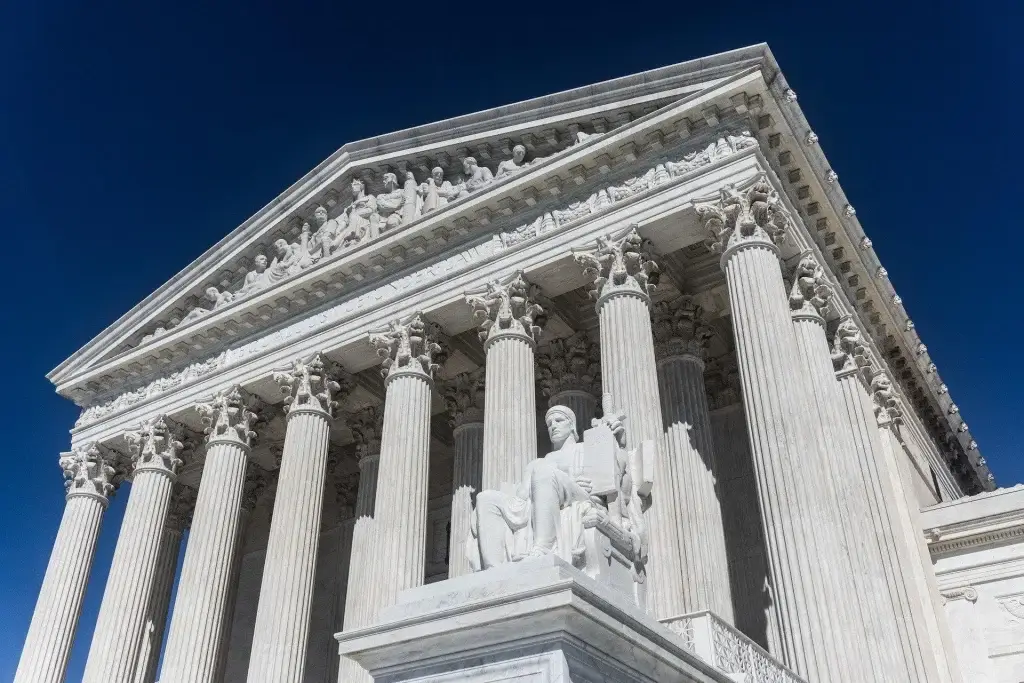
On Wednesday, the Supreme Court cleared the way for Illinois Rep. Mike Bost (R) to move forward with a legal challenge to the state’s mail-in ballot counting rules, ruling 7-2 that the Republican congressman has standing to sue.
Chief Justice John Roberts wrote the majority opinion. Justices Sonia Sotomayor and Ketanji Brown Jackson dissented.

CBS News reports:
“By carving out a bespoke rule for candidate-plaintiffs — granting them standing ‘to challenge the rules that govern the counting of votes,’ simply and solely because they are ‘candidate[s] for office’ — the court now complicates and destabilizes both our standing law and America’s electoral processes,” Jackson wrote.
Bost is challenging an Illinois law that allows mail-in ballots to be counted even if they arrive after Election Day, as long as they are postmarked by Election Day and received within two weeks.
The court’s decision does not determine whether Illinois’ ballot-counting law is legal. Instead, it addresses whether Bost has the legal right to bring the case in federal court.
“Under Article III of the Constitution, plaintiffs must have a ‘personal stake’ in a case to have standing to sue,” Roberts wrote. “They must, in other words, be able to answer a basic question: ‘What’s in it to you?’ Congressman Bost has an obvious answer: He is a candidate for office. And a candidate has a personal stake in the rules that govern the counting of votes in his election.”
The ruling reverses a decision from the U.S. Court of Appeals for the 7th Circuit, which found Bost lacked standing and upheld a lower court’s dismissal of the lawsuit. The Supreme Court sent the case back to the lower courts for further proceedings.
Bost and two presidential-elector nominees originally filed the lawsuit in 2022, arguing that Illinois’ extended deadline for receiving ballots violates federal law.
Lower courts had concluded that Bost’s claims of harm were too uncertain to support standing, with the appeals court describing the alleged harms as “speculative.”
Bost argued that extending the window for receiving mail-in ballots affects candidates by increasing campaign costs and creating operational burdens, including the need to continue get-out-the-vote efforts and monitor the processing and counting of late-arriving ballots.
The Supreme Court’s majority agreed that candidates have a direct interest in how election rules are applied.
The majority said candidates have “concrete and particularized interest in the rules that govern the counting of votes in their elections, regardless whether those rules harm their electoral prospects or increase the costs of their campaigns.”
“Their interest extends to the integrity of the election — and the democratic process by which they earn or lose the support of the people they seek to represent,” Roberts wrote.
The Trump administration backed Bost in the case.
READ NEXT: House Oversight Chair Moves to Hold Hillary Clinton in Contempt Over Epstein Probe