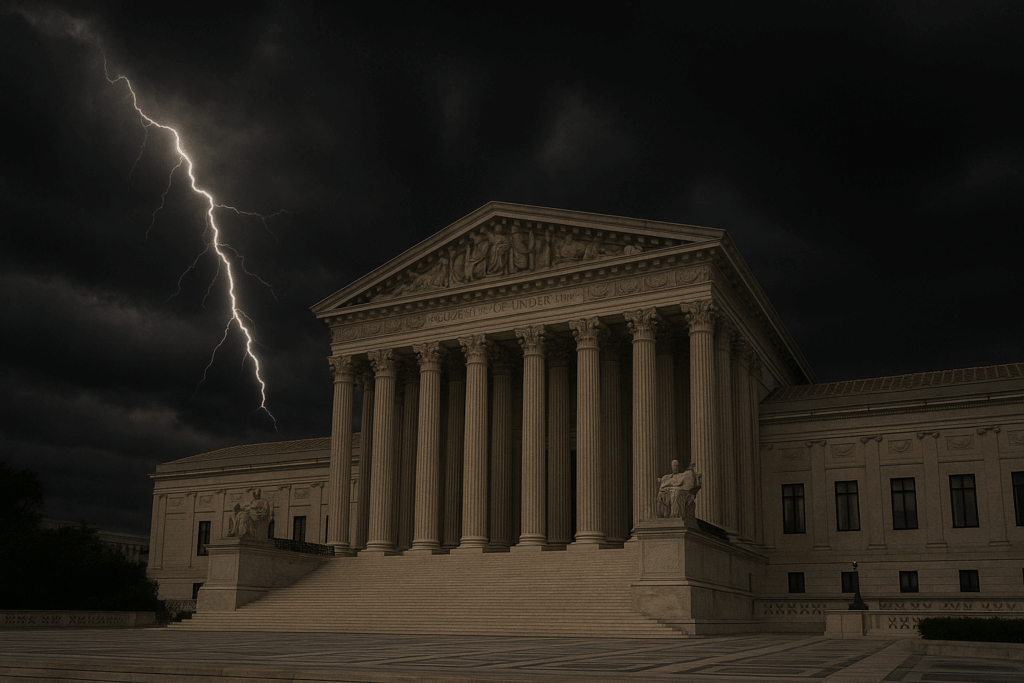
The Supreme Court appears ready to back President Donald Trump’s decision to fire two Democratic members of the Federal Trade Commission, a move that could rewrite how Washington’s independent agencies operate and expand presidential control over the federal bureaucracy.
A ruling is expected by mid-2026. If the Court delivers what its questions on Monday suggested, the decision could narrow or overturn nearly a century of precedent and leave dozens of agencies more exposed to political oversight than at any point since the New Deal.
The Case Before the Court
At issue is Trump’s removal of FTC Commissioner Rebecca Kelly Slaughter in March 2025, months before her term expired and without the statutory “cause” required for firing members of independent commissions. Trump had also removed another Democratic commissioner, Alvaro Bedoya.
A D.C. district court ruled the firing unlawful and ordered Slaughter reinstated, a decision a divided D.C. Circuit upheld. But in September, the Supreme Court stepped in and paused the reinstatement while it reviews the case.
The core dispute centers on Humphrey’s Executor v. United States (1935), the decision that shields commissioners at agencies such as the FTC, FCC, SEC, and others from at-will presidential removal. Under that framework, commissioners can be dismissed only for “inefficiency, neglect of duty, or malfeasance.”
A Direct Challenge to Longstanding Limits on Executive Power
The administration argues those limits no longer make sense. The Justice Department says modern independent agencies exercise significant executive authority and that the president must be able to remove commissioners who undermine his policies. Otherwise, the White House is held responsible for agencies it cannot fully control.
Slaughter and her supporters counter that Congress intentionally designed these agencies to be insulated from political swings. They say allowing presidents to fire commissioners over policy disagreements would politicize bodies meant to provide expert, stable oversight.
Critics of Trump’s position warn that eliminating for-cause protections would weaken the balance Congress built into the regulatory system and expose agencies to sudden policy shifts whenever partisan control changes.
Why This Case Matters Beyond the FTC
If the Court sides with Trump, the decision could pull the thread that unravels the structure of dozens of independent agencies. A ruling that guts or narrows Humphrey’s Executor would not just reshape the FTC. It would likely affect regulators across finance, labor, energy, communications, and even monetary policy.
As NBC News reported, the Court’s conservative bloc showed virtually no sign of shifting from its current trajectory. A few justices did raise the possibility that a president’s removal authority might require some limits, but offered little indication beyond that:
In one exchange with Slaughter’s lawyer, Amit Agarwal, conservative Justice Neil Gorsuch said the Humphrey’s ruling was “poorly reasoned” and suggested he would be a vote to overturn it.
“There’s no such thing in our constitutional order as a fourth branch of government that’s quasi-judicial and quasi-legislative,” he said, referring to the idea that independent agencies do not fit within any of the three branches of government defined in the Constitution: the executive, Congress and the courts.
Likewise, fellow conservative Chief Justice John Roberts said the Humphrey’s ruling is a “dried husk” that stands for little because the FTC has changed so much in the intervening 90 years.
He appeared to agree with the Trump administration’s view that the agency now exercises more executive powers than it used to, meaning the president, as head of the executive branch, should have more authority over it.
Roberts noted that when the Supreme Court addressed the issue in 1935, it was dealing with an agency that exercised almost no true executive power — which, he said, “may be why they were able to attract such broad support on the Court at the time.”
Below are 15 agencies most likely to be affected if for-cause protections fall.
Financial and Economic Power
Federal Reserve Board of Governors
- Controls interest rates and monetary policy. Its political insulation rests heavily on Humphrey’s and has long been treated as essential to financial stability.
Securities and Exchange Commission
- Oversees public companies, markets, and investor protections. Congress explicitly identifies it as an independent regulatory agency.
Federal Deposit Insurance Corporation
- Backstops bank deposits and handles failed banks. A key stabilizer in crises.
Commodity Futures Trading Commission
- Regulates derivatives and commodity markets central to energy and agriculture.
National Credit Union Administration
- Supervises and insures credit unions, another piece of the financial safety net.
Federal Energy Regulatory Commission
- Regulates interstate electricity and natural gas markets. Crucial to grid reliability and national energy strategy.
Markets, Consumers, and Tech
Federal Trade Commission
- The agency at the heart of the case. A ruling in Trump’s favor would make it easier for presidents to replace commissioners over disagreements on antitrust policy, tech regulation, or rule-making priorities.
Federal Communications Commission
- Controls broadband, media ownership, and spectrum. It is explicitly listed as an independent regulator in statute.
Consumer Product Safety Commission
- Sets safety standards and handles consumer-product recalls. Its independence has long been tied to Humphrey’s.
Consumer Financial Protection Bureau
- Partially independent. Its director’s removal protections were narrowed in Seila Law, but the agency still has structural features now under renewed scrutiny.
Labor, Workplace and Personnel
National Labor Relations Board
- Oversees union elections and labor-relations rules. Trump has already removed Democratic members; a favorable ruling would make mid-term purges routine.
Merit Systems Protection Board
- Protects federal workers from political retaliation. Its independence was tested in Trump v. Wilcox.
Equal Employment Opportunity Commission
- Enforces workplace anti-discrimination laws.
Safety, Environment and Infrastructure
Nuclear Regulatory Commission
- Oversees civilian nuclear facilities. Congress has long treated it as politically insulated.
Federal Maritime Commission
- Regulates international ocean shipping and port competition.
A Decision With Long-Term Reach
A ruling that empowers presidents to fire independent commissioners at will would reshape how future administrations deal with regulatory bodies and how Congress designs them. It would also influence related disputes already moving through the courts, including the challenge to the removal protections for Federal Reserve Board member Lisa D. Cook in Trump v. Cook.
The outcome could reset the boundaries between the branches of government and narrow the space where expert regulators operate outside direct political control. However the Court rules, the decision is likely to define the structure and independence of the regulatory state for decades.
READ NEXT: Dem Firebrand Makes Bold Move To Leave Congress