




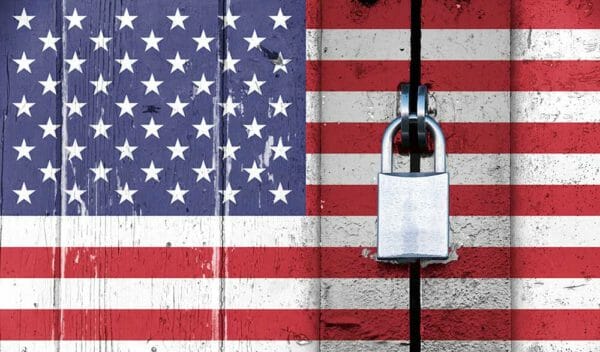
Illegal immigration continues to be one of the most divisive and passionately debated issues in American politics. As policymakers, advocates, and communities wrestle with how to balance border security with human rights and economic needs, public opinion plays a critical role in shaping the national conversation.
One week ago, American Liberty News conducted a nationwide to understand how our readers feel about illegal immigration, border security, and related constitutional issues. With debates over immigration policy reaching a fever pitch—fueled by recent news of violent protests, detentions, and deportations—our team wanted direct insights.
The results were striking, sometimes surprising, and overwhelmingly in favor of stricter immigration enforcement and dramatic policy reform. The responses indicate a high level of concern over not just border control but also the legal, economic, and cultural impacts of illegal immigration.
When asked how important it is to deport illegal immigrants with extensive criminal records (such as drug trafficking, rape, or assault), respondents were unequivocal: 100% said it is “critically important—no exceptions.” This uniformity reflects broad bipartisan or ideological agreement on the need to remove individuals who pose a public safety threat, regardless of other factors.
The total consensus underscores a key principle that many Americans appear to agree on: criminal behavior by individuals illegally in the country eliminates any possibility of leniency.
One recent controversy that has fueled public skepticism toward immigration leniency involves Kilmar Abrego Garcia, an accused MS-13 gang member and human smuggler whose deportation initially sparked a wave of Democratic support. Many high-profile Democrats publicly portrayed Abrego Garcia as a wrongfully deported “Maryland man,” emphasizing his family ties. Some even traveled to El Salvador to protest his removal and demanded that he be returned to the United States. However, the narrative quickly collapsed as more details emerged about his alleged gang affiliation and criminal background. The backlash has been swift and severe, with critics accusing Democratic leaders of blindly defending an individual with a dangerous past in order to score political points. The case has become an indictment on the Democratic immigration approach, often accused of being naive and out of touch.
While the previous question dealt with violent offenders, the next one asked about illegal aliens who have not committed any crimes other than their illegal entry or overstaying visas. Here, a strong majority (71%) still supported deportation, framing illegal presence itself as sufficient cause for removal. Another 28% said deportation should depend on the circumstances, perhaps suggesting support for leniency in cases involving long-term residency, dependent industries, or community contributions. Only 1% believed it was “not important” to deport non-criminal illegal immigrants.
The views expressed reflect a national trend: support for deporting all illegal immigrants has now become the majority position across the United States. In recent weeks, multiple major polls—including those conducted by CNN and the New York Times—have shown 54% or more of Americans backing the idea of deporting all illegally residing in the country, regardless of their criminal history or length of stay. This marks a significant shift from past years, when mass deportation was considered a fringe or hardline stance. The change seems to have been catalyzed at least in part by the Biden administration’s notoriously permissive enforcement practices.
The survey also asked whether children born in the United States to illegal immigrants should automatically become citizens. A commanding 81% said “No,” arguing for an end to birthright citizenship. An additional 18% supported citizenship only if at least one parent is a legal resident or citizen. Just 1% defended the current practice under the 14th Amendment, which guarantees citizenship to anyone born on American soil.
Upon his return to office, President Donald Trump immediately signed an executive order to end that practice, arguing it was based on a misinterpretation of the law. According to Trump and his legal advisors, the authors of the 14th Amendment never intended for the clause to apply to children born to illegal immigrants. This sparked immediate and widespread legal challenges.
Federal judges in three different districts—including Judge Boardman—sided with the challengers and issued nationwide injunctions blocking the executive order. The courts ruled that denying U.S. citizenship to a child born on American soil could not only violate constitutional protections but also risk rendering those children stateless, effectively without any recognized nationality. In a 6–3 decision, the United States Supreme Court ruled that the lower court judges exceeded their authority by issuing nationwide bans, but clarified that a class-action suit could provide national protections if approved. With the Supreme Court sending the issue back to the lower courts and setting July 27 as the earliest enforcement date, the legal fight is far from over.
White House attorneys agreed not to implement the policy any earlier than July 27. Meanwhile, the plaintiffs in the Maryland case are moving to have their lawsuit certified as a class action that would cover all illegal alien parents and their U.S.-born children. As the deadline approaches, both legal teams are bracing for what could be a landmark ruling that redefines the future of citizenship in America.
When it comes to broader constitutional protections, 90% of respondents believe that illegal immigrants receive too many legal protections under the U.S. Constitution. Only 9% supported allowing some, but not all, rights. No respondents favored equal constitutional rights for illegal aliens.
While courts have historically interpreted many rights—especially due process and equal protection—to extend to all persons in the U.S., regardless of status, this survey reflects a public sentiment sharply at odds with judicial precedent.
A related question asked whether illegal immigrants should receive “due process” before being deported. The results were heavily tilted toward swift removal: 72% favored quick deportation without a full legal hearing. Another 27% supported limited legal protections. Only 1 person in the sample favored full legal due process, a response too insignificant to register as even 1% in the final tally.
This further reinforces the dominant narrative in the survey: the majority of respondents see illegal presence as a crime that should be resolved quickly and decisively.
On the economic impact, 80% of respondents said illegal immigrants are a net drain on the economy, due to costs associated with healthcare, education, and law enforcement. 20% believed the pros and cons somewhat balanced out. No one in the survey saw illegal immigration as an overall economic benefit.
This result is consistent with the skepticism expressed throughout the survey. While immigration advocates often insist that illegal immigrants are taking the jobs “Americans won’t do,” and that their tax contributions—though limited—do help fund public programs, this sample remains largely unpersuaded by those talking points.
Three-quarters of those surveyed (77%) believe illegal immigrants hurt American workers by taking jobs and lowering wages. Another 23% believed the impact varies by industry. No one suggested that undocumented laborers do not affect American workers at all.
This result likely reflects economic anxieties and labor competition in sectors like agriculture, construction, and hospitality.
Interestingly, the public’s strong belief that illegal immigrants harm American workers stands in contrast to President Donald Trump’s fluctuating position on this very issue—particularly regarding agricultural labor and the hospitality industry. In the past few weeks, Trump has entertained deportation exemptions for illegal immigrants working at hotels and farms. While aggressively advocating for mass deportations and tighter border control, he has also suggested that certain industries—like farming and hotels—depend heavily on illegal labor to survive. While survey voters overwhelmingly support enforcement in principle, economic reliance presents challenges, even among immigration hardliners.
Perhaps the most emotionally charged question in the survey asked whether illegal immigration threatens American values and traditions. A dominant 93% answered yes, stating that it is “changing our culture forever.” Another 6% said it’s a balancing act, implying that while there may be some impact, diversity and tradition can coexist. Only 1% took the view that diversity is at the heart of American identity.
This overwhelming response suggests widespread sense of cultural decay and a strong desire among respondents to reverse it and preserve traditional American values. The sentiment may be driven by changes in language, religion, customs, and demographics in areas with high immigrant populations.
The first question in the survey asked whether veterans who served the country should be protected from deportation. An overwhelming 85% believed that military service should protect veterans that entered or remained in the country illegally from removal, though 53% of respondents said this protection should be afforded only if the veteran has a clean criminal record, indicating a belief in conditional leniency. The remaining 32% of those who believed in the exemption expressed unequivocal support for protecting any veteran from deportation, regardless of legal status or criminal history, suggesting that service to the country warrants permanent residence. On the other end of the spectrum, 15% took a stricter view, saying military service does not excuse someone from immigration laws.
The survey also raised the question of using the U.S. military to secure all borders, not just the southern border with Mexico. A staggering 89% supported deploying military forces to secure “every inch of America,” including the northern border with Canada. Only 11% thought the military should focus solely on the southern border.
This result reflects growing concern over border security beyond the traditional focus on the south. The inclusion of Canada—often viewed as a low-risk border—suggests heightened national security concerns among respondents, possibly driven by recent reports of illegal crossings in northern states such as New York.
Despite the recent death of a Canadian citizen in ICE custody in Florida, 66% of respondents said their views on detention policies remained unchanged. For them, the incident was seen as tragic but not necessarily indicative of systemic failure. Another 32% said the event made them more likely to support tougher detention measures, believing that enforcement must be stringent. Only 2% said the incident made them less likely to support strict detention.
Another survey question asked whether respondents supported the construction of “Alligator Alcatraz,” a high-security facility surrounded by natural deterrents such as alligators and snakes.
92% of respondents were in favor of the idea, signaling a readiness to embrace extreme, even theatrical, methods of deterrence. An additional 6% said they would consider the idea pending legal review. Only 2% outright rejected the concept as too extreme.
Taken together, these survey results paint a clear picture: the overwhelming majority of respondents favor stricter immigration enforcement, reduced legal protections for undocumented immigrants, and more aggressive border security tactics. From supporting the end of birthright citizenship to endorsing deterrents like Alligator Alcatraz, respondents signaled a desire for decisive, unapologetic measures to curb illegal immigration.
While some nuance exists—particularly around veterans—most responses reflect frustration with the status quo and a belief that illegal immigration poses threats not just to the economy, but to American identity and national security.
These findings offer a valuable lens into the evolving national debate—one where concerns over legality, sovereignty, and cultural cohesion increasingly shape the public’s views on what it means to be American.
READ NEXT: Trump Admin Greenlights ‘Alligator Alcatraz’ For ICE Detainees

Seijah Drake was born in Boston, MA, where she developed a penchant for writing early on and a passion for politics in college. After college she worked briefly for a conservative media in New York before relocating to the Greater D.C. Area to pursue a career in political marketing. She now resides in the free state of Florida.























Really would like to see the raw numbers to add some perspective on participation.