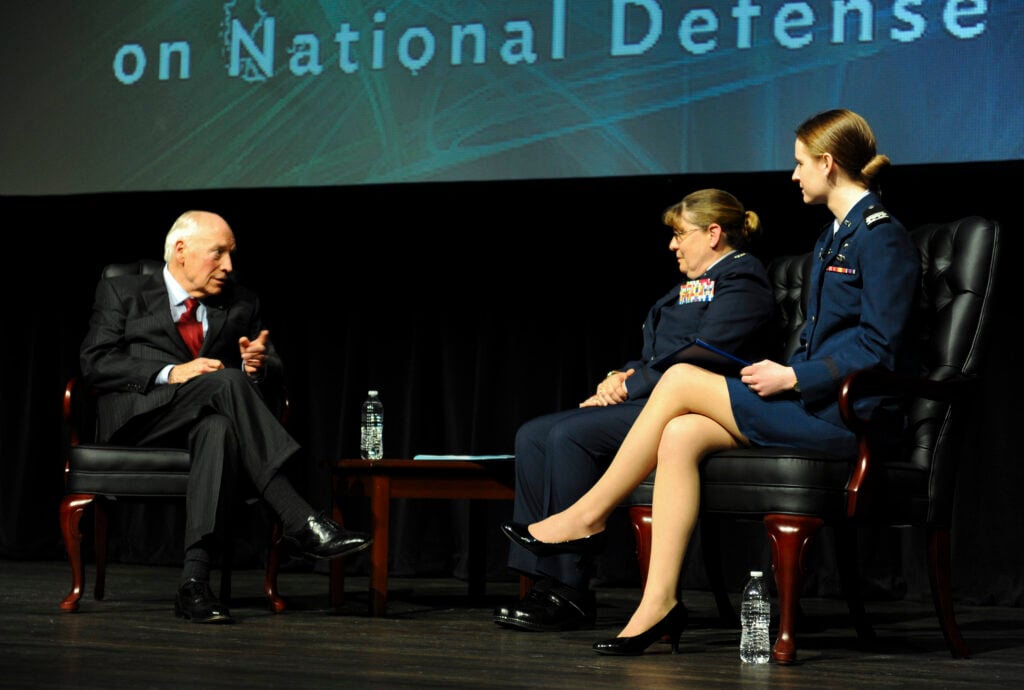
Dick Cheney, the former vice president who helped steer America through the post-9/11 era and reshaped the role of the vice presidency itself, died Nov. 3 at age 84 due to complications from pneumonia and long-term cardiac and vascular disease, his family announced.
Cheney’s political career spanned five decades and several Republican administrations. A fierce advocate for expansive presidential authority and a defining voice in the global War on Terror, Cheney was both praised for his strategic influence and criticized for the sweeping policies he helped shape from inside the highest echelons of government.
From Wyoming to the White House
Born Jan. 30, 1941, in Lincoln, Nebraska, and raised in Casper, Wyoming, Cheney built a career marked by rising influence inside the Republican Party and Washington’s national security establishment.
Cheney served as Wyoming’s sole representative in Congress before joining President Gerald Ford’s administration as White House chief of staff. Under President George H.W. Bush, he became secretary of defense — one of the most powerful roles in Washington — where he oversaw Operation Desert Storm and helped guide U.S. policy through the end of the Cold War and the dissolution of the Soviet Union.
His most consequential role came later, as the 46th vice president under George W. Bush from 2001 to 2009. There, he emerged as a driving force behind America’s response to the Sept. 11 attacks — and, most controversially, the leading advocate for the 2003 invasion of Iraq, arguing that Iraq possessed weapons of mass destruction and maintained ties to terrorism.
He later defended the decision, saying it was justified by the intelligence available at the time and that Saddam Hussein’s removal left the world safer.
Two decades later, the true death toll of the Iraq War remains contested. Estimates range from 150,000 to more than a million people, depending on who’s counting and how. The toll includes civilians lost to violence, disease, and the chaos that followed Hussein’s fall. In all, 4,508 U.S. military personnel were killed.
Redefining the Vice Presidency
Cheney is widely seen as the most powerful vice president in American history. He didn’t just attend meetings and break Senate ties — he reshaped the office into a key command post for intelligence, defense, and foreign policy.
Following 9/11, Cheney championed the use of warrantless surveillance programs and “enhanced interrogation techniques.” His behind-the-scenes influence helped tilt the Bush administration toward a muscular approach to national security and an expanded view of presidential authority.
A Divisive Legacy
Supporters saw Cheney as clear-eyed and unflinching — a leader who prioritized national defense over political calculation. Most conservatives at the time credited him with helping to keep the United States safe during one of its most turbulent eras.
Critics — including a growing number of Republicans as the party shifted toward populism in later years — pointed to the long-term consequences of Cheney’s policies. No weapons of mass destruction were ever found in Iraq, and civil liberties groups condemned the domestic surveillance programs he helped authorize.
Health challenges also marked Cheney’s public life. He suffered multiple heart attacks starting in his 30s and received a heart transplant in 2012.
Breaking with His Party
In recent years, Cheney distanced himself from the direction of the GOP under Donald Trump. He strongly backed his daughter, Rep. Liz Cheney, in her outspoken opposition to Trump’s efforts to overturn the 2020 election — even as it cost her a leadership post and ultimately her seat in Congress.
Looking Ahead
Cheney’s death is likely to rekindle debates about the limits of executive power, especially in an era of growing partisanship and presidential overreach. His influence on how the vice presidency operates will echo in administrations to come.
Memorial services and official tributes are expected in the coming days as Washington reflects on the life and impact of a man who reshaped the American political and security landscape — and remained unapologetic about it.
This is a breaking news story. Please check back for updates.
READ NEXT: Trump Assembles 50-State Rapid-Response Squad — Are You Ready?