

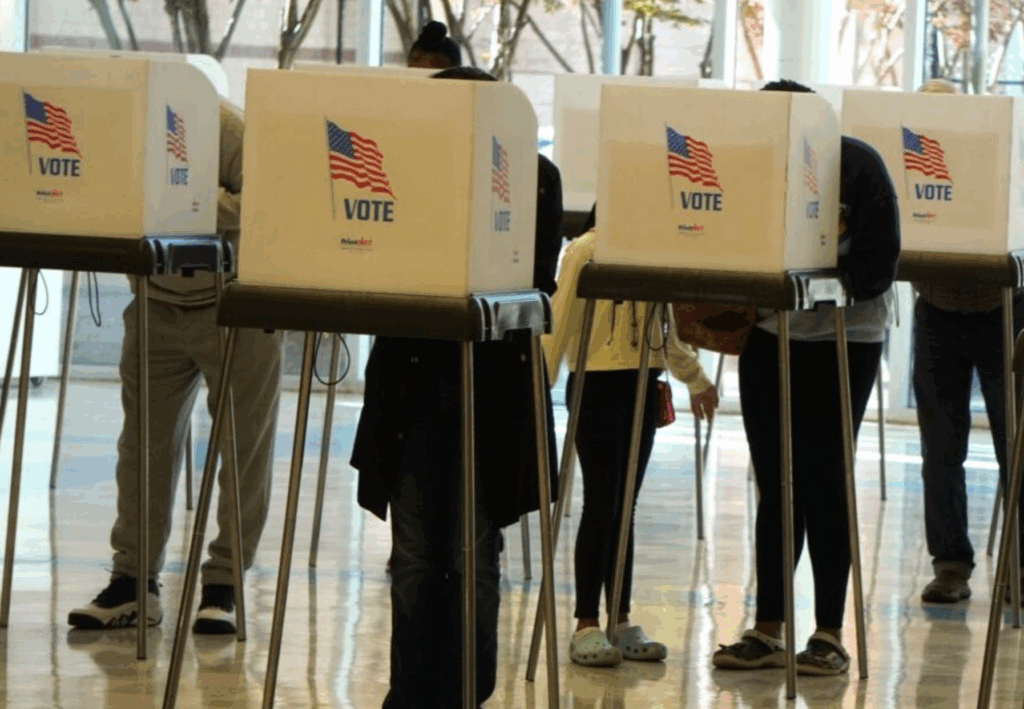
Who decides who counts as a Republican? It is not a rhetorical question. Nor is it a question of philosophical identity. It is, quite literally, a question of voter eligibility. And in Texas, it is fast becoming the most consequential internal dispute since the Tea Party rebellion of 2010. The fight over whether Texas Republicans should adopt a closed primary system, thereby excluding Democrats and independents from GOP candidate selection, is not just administrative. It is existential. Because at stake is whether the Republican Party in Texas remains a party of conservatives, or becomes the safety valve for RINO donors, consultants, and media who find democratic ideas unpalatable, but are desperate to stymie the populist right.
One must begin with the nature of open primaries in Texas. In their current form, Texas primaries allow any registered voter to choose which party’s primary to vote in. There is no party registration. In theory, this maximizes participation. In practice, it enables manipulation. When Democratic and independent voters cross over into Republican primaries, especially in Republican-dominated districts, they distort the outcome. The Republican nominee may be the choice of a majority of primary voters, but not of a majority of Republicans. This distinction is not semantic. It is strategic. In a state where the GOP primary is often the only competitive election, Democrats have strong incentives to help nominate the weakest, or most agreeable, Republican.
This is not mere speculation. It is demonstrable. Consider the 2021 special election in Texas’ 6th Congressional District. The Trump-endorsed conservative Susan Wright lost to Jake Ellzey, a more moderate Republican who benefited from what analysts estimate were thousands of crossover Democratic votes. Or take the 2020 runoff in Texas Senate District 30, where Shelley Luther, a conservative firebrand, was defeated by Drew Springer, who ran to her left and actively sought Democratic participation. And most recently, the January 2024 runoff in Texas House District 2, where Jill Dutton edged out Brent Money, the conservative favorite, thanks in part to an estimated 11 percent of voters who had a history of voting in Democratic primaries. These are not flukes. They are the predictable result of a system that invites ideological outsiders to shape a party they do not belong to.
The uniparty class knows this. Indeed, they depend on it. Moderate Republicans in Texas, particularly those tied to the donor class or the legislature’s leadership, have built their careers on threading this needle: conservative enough to fend off challengers in a red state, but moderate enough to earn glowing profiles from left-leaning press. They are, in effect, Democratic proxies. And the tool that keeps them in power is the open primary.
One need only look at the names lining up against closing the primary to understand who benefits from the current system. In Washington, Rep. Tony Gonzales, a member of the Republican Main Street Partnership, has made clear his discomfort with the prospect of a closed primary, which would tilt the field in favor of conservatives. His colleague Michael Burgess, also of the same centrist alliance, shares this view. And Sen. John Cornyn, though at times coy about the matter, knows full well that a closed primary would empower the very voters now rallying behind his potential successor, Attorney General Ken Paxton.
In Texas itself, the lines are even clearer. Speaker of the House Dade Phelan owes his political survival to Democratic crossover voters. So, too, do Republican representatives like Charlie Geren, Cody Harris, Jerad Patterson, Ken King, Morgan Meyer, Angie Chen Button, Ryan Guillen, Drew Darby, Stan Lambert, and John Lujan. For these incumbents, closing the primary would be not just inconvenient, it would be disqualifying. They would lose. And they know it.
The practical effect of open primaries is thus a kind of ideological laundering. The GOP brand is used to elect candidates who do not reflect the party’s stated platform. This is not merely a matter of policy drift. It is a structural vulnerability. When party nomination processes are open to non-members, the party ceases to have boundaries. And without boundaries, it ceases to have integrity.
Some will object that primaries ought to be open, that in a democratic society, all voters should have a say in who runs for office. But this misunderstands the nature of political parties. Parties are not public utilities. They are private associations. Just as a labor union has the right to elect its leadership without the input of management, a political party has the right to select its nominees without the interference of rival partisans. The right of association is meaningless if it does not entail the right of exclusion.
And there is public support for this. In the March 2024 primary, 73 percent of Republican voters supported a ballot proposition endorsing closed primaries. The party, at its 2024 state convention, adopted Rule 46, designed to restrict participation in the GOP primary to those who either register as Republicans or affirm affiliation. And as of June 2025, the State Republican Executive Committee is preparing to enforce it.
The resistance is fierce. Lawsuits are likely. The media will howl. Editorial boards will accuse the Texas GOP of disenfranchisement. But these are not good faith critiques. They are defenses of the status quo. A status quo that allows liberal operatives to dictate conservative outcomes.
To allow this regime to persist is to accept permanent minority status within one’s own party. Conservative candidates will continue to be outspent by RINO incumbents backed by business PACs like Texans for Lawsuit Reform, and outvoted by Democratic crossovers in low-turnout primaries. In such a system, conservatism is not defeated. It is excluded.
There are historical parallels. In the 19th century, party caucuses were limited affairs. Participation was restricted to active members. The goal was coherence, not mass appeal. That model was overturned by the progressive reforms of the early 20th century, which sought to democratize candidate selection. But these reforms were premised on party registration. Where that registration exists, as in most states with closed primaries, party identity is meaningful. In Texas, it is not. Anyone can pick up the Republican label and wear it to victory, so long as enough non-Republicans join them.
This cannot endure. The party must decide whether it wishes to be a vessel for conservative principles, or merely a ballot line for those who can afford it. Closing the primary is not exclusionary. It is clarifying. It draws a line between those who wish to participate in the Republican project and those who wish only to disrupt it.
If this battle is lost, the consequences will be generational. The infrastructure of the uniparty will remain intact. Republican voters will be outmaneuvered by Democratic operatives who have no intention of competing honestly. The base will become disillusioned. Turnout will fall. And the Texas GOP will become, not a conservative party, but a clearinghouse for moderate functionaries with enough money to survive a challenge.
This is not about procedural preferences. It is about whether the conservative movement has a future in Texas. The mechanism is simple. Let Republicans pick Republican nominees. No more, no less.
If you enjoy my work, please consider subscribing: https://x.com/amuse.
READ NEXT: Trump DOJ Launches Legal Bombshell On Deep Blue State
Sponsored by the John Milton Freedom Foundation, a nonprofit dedicated to helping independent journalists overcome formidable challenges in today’s media landscape and bring crucial stories to you.
Sponsored
Radical Democrats want to destroy Chip Roy. If we lose him, the Swamp wins. Stand with Chip now.



















THIS ISSUE NEEDS TO BE FIXED!!!!!! I HAVE NO DESIRE TO HAVE NON-REPUBLICANS VOTING IN ANY OF OUR PRIMARIES!!!
The biggest problem is that anyone can declare as a party candidate. The parties do not seem to have a say as to who can run. They don’t have to be a member of the party or even agree with the party platform. It’s why a Communist can run on a Democrat ballot and not have to represent anything the party stands for. Once you’re on the ballot, there is a good chance that you can make it through the primaries. There are no solid rules as to what qualifies a person to be on the ballot for that party. Until a party has a system that gives it the final say-so as to who can run, it will be a free-for-all.
It is important to have a closed primary. A party member, such as a Republican, joins the party because he or she can have a say in who they would be able to vote for. As it is, primaries are not widely attended by people. Outsiders therefore can have a field day wrecking many potential candidates because they get their people out. It is an obvious tactic to control the system. And the question of who decides who is a Republican is an important question, because, in the system, anyone can declare a candidacy on a party line and they don’t have to be a party member or even follow the platform, and if they get selected by a low turn-out event, they are the candidate. I’m sure that most Democrats would not favor a Socialist/Communist for a major office, but this happened in NYC and is how Communists around the world have elected their people. Communism is a one-way-street, and they don’t easily relinquish control. A party which stands for something should take more care as to who they will allow to represent the party on the ballot. Otherwise, we end up asking “where did he come from?” The answer is that he put his name on the ballot, and no one protested. Elections are strongly attended, but they merely come down to the choices that were selected in the primaries. Some day we’ll realize that the primaries are actually more important than the elections themselves.
ALL states should formally recognize the primaries ARE NOT government functions. They are PARTY functions to determine who the PARTY members wish to support in the general election. Anything other than a closed primary is like letting people that don’t even want to buy shares in a company vote on the Board of Directors.