




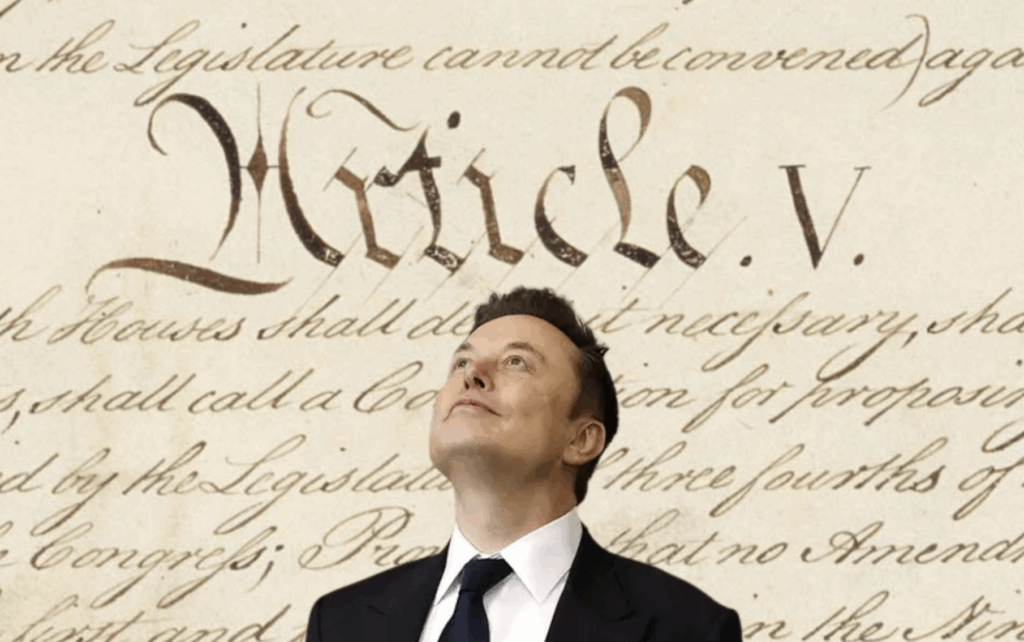
Ben Shapiro and Mark Levin want Elon Musk to abandon the America Party and throw his considerable influence behind the Convention of States movement. Their message is seductive: use the Constitution against itself, outflank the inertia of Congress, and restore the Founders’ vision by rewriting their handiwork. Musk, whose brief tenure at DOGE proved him capable of cutting bureaucratic waste, is seen by some as the ideal champion for this constitutional experiment. But the deeper one looks into the Article V convention project, the more it resembles not a scalpel for reform, but a pipe bomb for the republic.
Pressure builds for Musk to ditch third party in favor of backing Convention of States https://t.co/GoBe8oqzqH
— John Solomon (@jsolomonReports) July 9, 2025
The convention route, as permitted under Article V, allows two-thirds of state legislatures to trigger a national assembly for proposing amendments. This is not mere folklore, it is constitutional text. But that text, though brief, is dangerously vague. It offers no rules of order, no agenda-setting mechanism, no procedure for delegate selection or voting, and no clear guardrails on scope. To believe this process can be controlled is to believe that Congress can be counted on to yield its power voluntarily or that X comment threads produce sound governance.
The only historical precedent for such a convention is the Philadelphia meeting of 1787, a summit called to revise the Articles of Confederation. What emerged, of course, was a complete replacement. The delegates exceeded their mandate, rewrote the charter wholesale, and changed the ratification process itself. Madison, Hamilton, and Jay all warned explicitly against trying it again. Madison wrote that a new convention would be attended not by philosophers but by “violent partisans,” who would use the forum to “sap the very foundations” of our system. Hamilton, in Federalist No. 85, called the idea a dangerous gamble and explicitly disclaimed the wisdom of reconvening the experiment. Their fears, voiced at the inception of the republic, still hold.
What of the notion that a convention today could be limited to specific topics? That is the mainline defense offered by groups like the Convention of States, who claim their agenda is narrow: a balanced budget amendment, term limits, perhaps reigning in federal agencies. But this is fiction, not law. Former Chief Justice Warren Burger flatly declared that no authority exists to limit what a convention may consider once convened. Congress can call it, yes, but it cannot police its content. Delegates would be free to propose whatever amendments they please. A convention, once opened, is self-governing. And like Pandora’s box, once opened, it cannot be shut.
There is no Supreme Court precedent establishing that states can limit their delegates’ votes. Statutes in places like Florida and Indiana that purport to criminalize “rogue” delegate behavior are, in all likelihood, unconstitutional. Delegates at a constitutional convention act not as agents of state law, but as agents of the people. They exercise federal authority, and therefore enjoy immunity. You cannot both claim a convention is an exercise of national sovereignty and then handcuff its emissaries. That is political and legal incoherence.
And even if the convention limits itself to a short list of items, who writes those items? Who drafts the amendments? Who determines the voting thresholds within the body? Will votes be allocated one per state, thereby handing Wyoming the same influence as California? Or will it be proportional to population, giving urban-dominated blue states far more say? The Constitution does not say. If you think you know the answer, you are simply guessing.
The ratification hurdle, requiring three-quarters of the states to approve any amendment, is often cited as a firewall. But that too may prove illusory. The 1787 convention altered the ratification rule with the stroke of a quill. They declared that nine of thirteen states would suffice. Why couldn’t a modern convention do the same? Why should we assume a body vested with constituent authority, unmoored from existing precedent, would feel any obligation to play by inherited rules?
That such a risk is even entertained, let alone promoted, by serious conservatives should be alarming. To be clear, I fully support the substance of the reforms championed by the Convention of States movement, balanced budgets, term limits, and a return to constitutional boundaries are aims I share without reservation. But the mechanism proposed to achieve them is recklessly flawed. The same political movement that argues government is too erratic, too compromised, too corrupt to manage our currency or our borders now wishes to hand it a scalpel and say: perform surgery on the Constitution. This is not courage. This is a misadventure in utopianism.
Even the best intentions can be hijacked. What begins as a push for term limits or a budget cap may end with a proposed repeal of the Second Amendment, a constitutional right to taxpayer-funded abortion, or an amendment that codifies speech restrictions in the name of misinformation control. California has already signaled its intent: Gavin Newsom called for a convention to introduce sweeping gun-control provisions. Liberal groups like Wolf-PAC have spent years campaigning for a convention to overturn Citizens United. These are not idle threats. These are battle plans waiting for the battlefield.
It is no accident that opposition to an Article V convention spans the ideological spectrum. The John Birch Society and the ACLU rarely share concerns. On this, they do. The NAACP and Eagle Forum, groups as politically distant as any in American life, both oppose it. Why? Because each sees the hazard. Liberals fear a red state coup. Conservatives fear a blue state one. And both are right to fear. The problem is not who gains control of the convention. The problem is that no one can. That is the entire point of the warning.
There is a touch of tragic irony in watching the American right, burned for decades by liberal court decisions, now flirt with a process that could turn the judiciary’s worst instincts into permanent constitutional fixtures. Conservatives complain, rightly, that progressives wish to make the Constitution a living document. But what could possibly make it more “living” than handing it to a mob of 500 unelected delegates, half of whom will be trial lawyers, activist professors, or technocrats with ideological axes to grind?
Supporters like Levin and Shapiro mean well. Their diagnosis of Washington’s dysfunction is correct. The permanent class has no intention of reforming itself. But their prescription is reckless. If the argument is that Congress is too broken to legislate responsibly, then handing the power of amendment to a convention whose makeup and conduct we cannot foresee is the height of folly.
Perhaps most crucially, this entire debate is moot, for now. Democrats control enough state legislatures to block the thirty-four state threshold needed to trigger the process. No such convention is on the immediate horizon. So why press the issue? Because the temptation is there, and because Musk’s America Party, while flawed, at least attempts reform within the existing structure. The Convention of States would blow that structure apart. Elon Musk is a disruptor, yes, but even he understands that disruption without clarity is just chaos in costume.
Constitutional fidelity is not served by constitutional roulette. The temptation to rewrite is strongest precisely when our institutions seem weakest. But those moments demand restraint, not revolution. In a time of crisis, the wise man holds to the mast, he does not burn the ship and try to build a new one mid-storm.
— @amuse (@amuse) July 6, 2025
If you enjoy my work, please consider subscribing: https://x.com/amuse.
Sponsored by the John Milton Freedom Foundation, a nonprofit dedicated to helping independent journalists overcome formidable challenges in today’s media landscape and bring crucial stories to you.
READ NEXT: Bongino, Patel Reportedly On Brink Of Resignation Over DOJ Epstein Memo























Opening the constitution to an overhaul at this time is an invitation to disaster The nation is too evenly divided right now and giving the left even a small chance to change the rule of law to he rule of the left could wipe out our 2A rights. Don’t allow the left to make DEI and open borders the law of the land. Don’t think that just because you think you have a good idea somebody else might have the money and corrupt people in place to mess it up.
Having been involved with the Constitutional Convention movement for the last few years, I think that the only ones who just panic over this idea would be the Far Left. The Convention would be able to tackle such things as term limits (which will never happen if politicians decide its fate), a balanced budget (imagine big government pushing for this), and a few other things that could actually bring democracy into the whole process. This would be a good direction for Musk, better than a new political party. Even Gov. Ron thinks it’s a good direction for him. If Musk can get on board with this, I think it’s a great thing.
I don’t think I’d characterize one of the Constitution’s checks and balances as “using the Constitution against itself.” The Founders included this mechanism precisely for the case of the federal government refusing to restrain itself.