

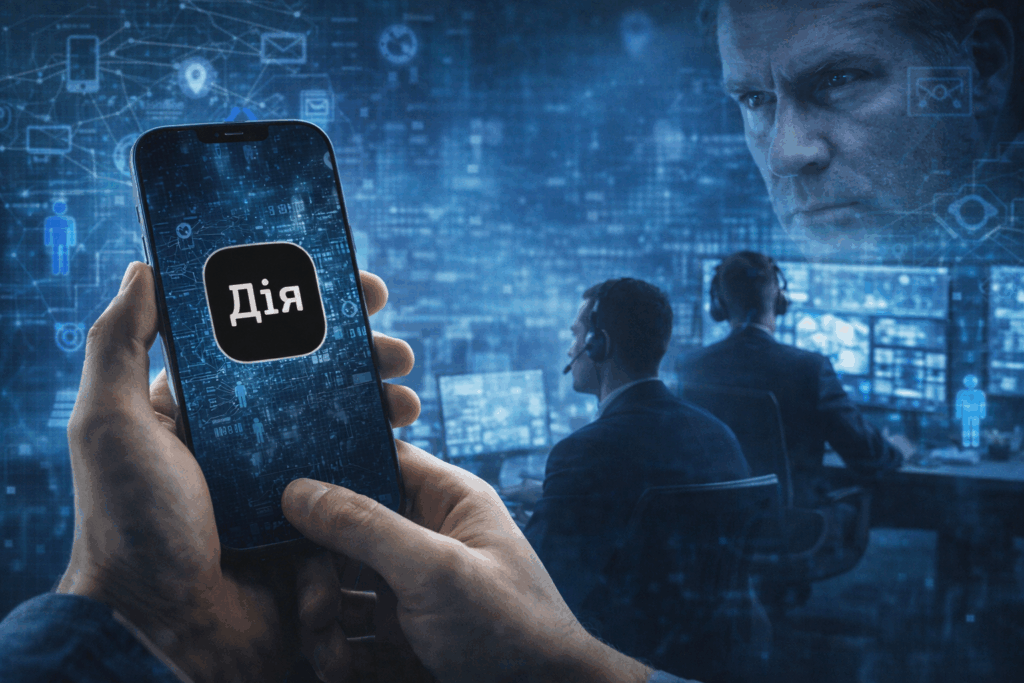
In modern politics, it is easy to forget how quickly a tool of convenience can become a mechanism of control. Ukraine’s DIIA app illustrates this danger vividly. More than 70% of Ukrainians rely on it for identity, payments, interactions with the state, and even wartime reporting. It is remarkable that a single application has become so deeply woven into daily life that opting out is nearly impossible. This fact alone raises hard questions, and when one considers the application’s origin in a USAID program, the concerns sharpen. USAID’s long relationship with U.S. intelligence is not speculative; it is a matter of record. The organization has served both humanitarian and strategic aims, and in several cases, its technological initiatives have blurred those lines. The Cuban social media platform USAID seeded in 2010 is one such example. The question is not whether USAID has ever aided intelligence work, but rather what follows when a tool of its design becomes the backbone of civic participation in another country.
Recent growth figures underscore how deeply that backbone now runs. Ukrainians continue to use DIIA at extraordinary rates, with more than 22 million active users by mid-2025 and sustained growth of over 100,000 new users each month. The app now contains more than 140 features, including digital IDs, passports, driver’s licenses, administrative filings, and integrations with banking and secure document storage. Ukrainians on 𝕏 routinely discuss its role in daily life and its resilience even amid war. This level of adoption demonstrates that DIIA is not a marginal experiment but a central platform for the country’s digital infrastructure, which only heightens the concerns raised above.
To understand why this matters, imagine a citizen using DIIA to vote, pay taxes, collect documents, receive benefits, and report suspected collaborators. Each of these tasks appears benign on its own. Together, they describe a digital system that sits atop identity, finance, political expression, and policing. A system of that scope becomes an information funnel, and whoever controls the funnel gains extraordinary influence. A reader might ask whether this sort of integration is simply modern governance. After all, digital services reduce friction, cut corruption, and deliver faster results. Ukraine sought precisely these benefits when it pursued e-governance reforms. Yet convenience and concentration are not the same thing. A refrigerator simplifies daily life, but it lacks the power to track your movements, predict your preferences, or mediate your relationship to the state. An everything app can do all of that.
Some might respond that DIIA empowers citizens rather than government. It stores digital documents securely, gives residents access to services previously locked behind bureaucracy, and allows rapid communication during war. These benefits are real. But they sit beside a second layer of capability that deserves equal attention. When an application becomes the mandatory gateway to civil participation, autonomy shrinks. When the same app becomes the preferred channel for reporting neighbors in wartime, the social fabric strains. Human beings are vulnerable to suspicion under stress, and a tool that encourages reporting by simplifying its mechanics risks accelerating destructive dynamics. What begins as patriotic vigilance can slide into a climate of fear when the scorekeeping is centralized, the stakes are high, and the consequences are opaque.
One might wonder whether the CIA’s indirect association with DIIA through USAID is irrelevant. After all, foreign aid groups often partner with local governments on technical projects. Yet history matters because it informs risk. USAID has built communication platforms for political populations before, and in some instances, the aim was not neutral. This pattern does not prove that DIIA is a surveillance platform, but it does justify scrutiny when such a large share of a nation’s private interactions are routed through a system tethered to an agency with a mixed operational history. Intelligence work in conflict zones tends to blur lines because the incentives to gather data surge, and tools already in wide civilian use become tempting channels.
Ukraine’s war against Russia magnifies these issues. In wartime the boundary between military necessity and civilian privacy often collapses. Governments ask for greater powers, citizens comply out of solidarity, and temporary measures harden into normal practice. If 70% of a nation’s population routinely uses a single platform, the pressure to extend its monitoring functions grows. A digital ID connected to voting can be justified in emergencies, but once normalized, it serves as an infrastructure for pervasive social management. The data trails left by payments, communications, and location based interactions create profiles that can be analyzed, correlated, and repurposed by domestic security services and foreign partners alike. This observation is not speculative, it follows from the logic of large scale data integration.
Consider the analogy of a central switchboard. In early telephony, a single point of routing gave operators immense access to information about who called whom, when, and how often. Nothing about the wires was malicious, but the architecture enabled monitoring. DIIA functions as a modern switchboard, routing diverse aspects of life through a common interface. The deeper the integration, the greater the insight into behavior. A thoughtful reader might ask whether encryption, decentralization, or strong privacy laws counteract these risks. They help, but tools of this scale generate metadata. Metadata alone reveals patterns that are sufficient for behavioral prediction and political mapping. Intelligence agencies rarely need the content of messages to understand the structure of a society. They need the connections.
This is why the CIA’s historical posture matters. The agency works with vast streams of metadata, and USAID projects have created channels for gathering such data in unstable regions. When a platform like DIIA emerges with financial, civic, and social functionality, the possibility that metadata could be shared, accessed, or leveraged by partners becomes a legitimate concern. Even if no improper access occurs, the structural risk remains. A system that can be misused will eventually be misused. Democracies must pay attention to these possibilities before crises make them unavoidable.
Another question arises. What are the safeguards within Ukraine to limit abuse? The country has taken steps to strengthen its institutions, but war strains oversight. Concentrated executive power becomes more common in conflict, and the temptation to use digital tools for political ends increases. Governments under threat may justify expanded surveillance in the name of security, and they may redefine dissent as disloyalty. When civic participation and state monitoring pass through the same app, the danger escalates. A political opponent who refuses to use DIIA could be treated as uncooperative. A critic who uses it can be mapped, profiled, and monitored. The ambiguity itself chills speech.
Some argue that Ukraine’s situation is unique and that such integration is necessary for a society pressed by invasion. Even if true, this does not remove the broader implications. USAID is exporting the DIIA model to other nations such as Colombia, Kosovo, Zambia, and Estonia. These countries are not war zones, and their adoption of a U.S.-backed everything app creates new dependencies. Once a state’s bureaucratic and civic processes rely on a foreign-designed digital system, autonomy shifts. Control of the codebase, updates, security infrastructure, and data handling policies becomes as consequential as control of airspace or currency. Nations may not realize how much authority they delegate when they install a foreign-built digital nervous system.
There is also a deeper philosophical point. Freedom is not only the absence of coercion, it is the presence of meaningful alternatives. A platform that acts as a gatekeeper for identity, finance, and political participation effectively narrows the field of legitimate action. If you must use the app to vote, transact, and communicate with the state, then you are no longer choosing the technology; the technology is choosing for you. A society committed to individual liberty requires space for dissenting methods. When participation is only possible through a single digital portal, the architecture of the system influences the structure of civic life.
Perhaps the most troubling aspect is the normalization of surveillance through convenience. People accept tradeoffs when they receive immediate benefits. If DIIA makes daily life easier, citizens rarely ask how their data might be used tomorrow. Yet political systems change, leadership changes, alliances shift, and tools remain. History teaches that a mechanism built for one purpose is often repurposed for others. A wartime reporting function can become a peacetime policing tool. A payment system can become a financial control lever. A digital ID can become a political loyalty test. None of this requires malice. It requires only opportunity and insufficient restraint.
Supporters of DIIA highlight its efficiency and innovative design, and those advantages are real. But strong democracies distinguish between what is technically possible and what is politically wise. Centralization brings risks that no layer of encryption can fully resolve. The problem is not the interface; it is the concentration of authority behind it. When the agency that helped build the platform has a record of involvement in covert operations, prudence demands scrutiny.
The rise of DIIA is not an argument against technology. It is an argument for architecture that respects limits. Distributed systems reduce the risk of concentrated abuse because no single actor holds all the keys. A federation of services allows citizens to interact with the state without funneling everything through one channel. Ukraine could adopt such models as it rebuilds, and nations considering similar platforms should evaluate alternatives that preserve both efficiency and autonomy.
Some might ask whether these warnings are exaggerated. After all, many countries use digital ID systems. But digital ID is only one component of DIIA. The application intertwines identity, payments, voting, communications, reporting, and benefits into a single container. This degree of convergence is unusual even among technologically advanced democracies. Estonia, often cited as a model of e-governance, uses distributed services and robust legal safeguards that limit the state’s access to data. DIIA’s unified design does not provide the same structural guardrails.
The lesson is clear. Digital infrastructure shapes political outcomes. A centralized platform gives governments unprecedented visibility into private life, and when that platform is built with foreign assistance, the circle of influence widens. Ukraine’s embrace of DIIA reflects its desire for modern governance, but the long-term implications demand careful reflection. If convenience is allowed to outrun prudence, then democratic societies risk sleepwalking into systems that erode the freedom they aim to protect.
If you enjoy my work, please subscribe: https://x.com/amuse.
Sponsored by the John Milton Freedom Foundation, a nonprofit dedicated to helping independent journalists overcome formidable challenges in today’s media landscape and bring crucial stories to you.
READ NEXT: Shock Report: Inside The Secret Feud Between Key Trump Officials



















Maybe it’s time to pull the CIA power.
Very 666 & scary if adopted worldwide
Rerun 1930s+ Germany
why I wont use Crypto