

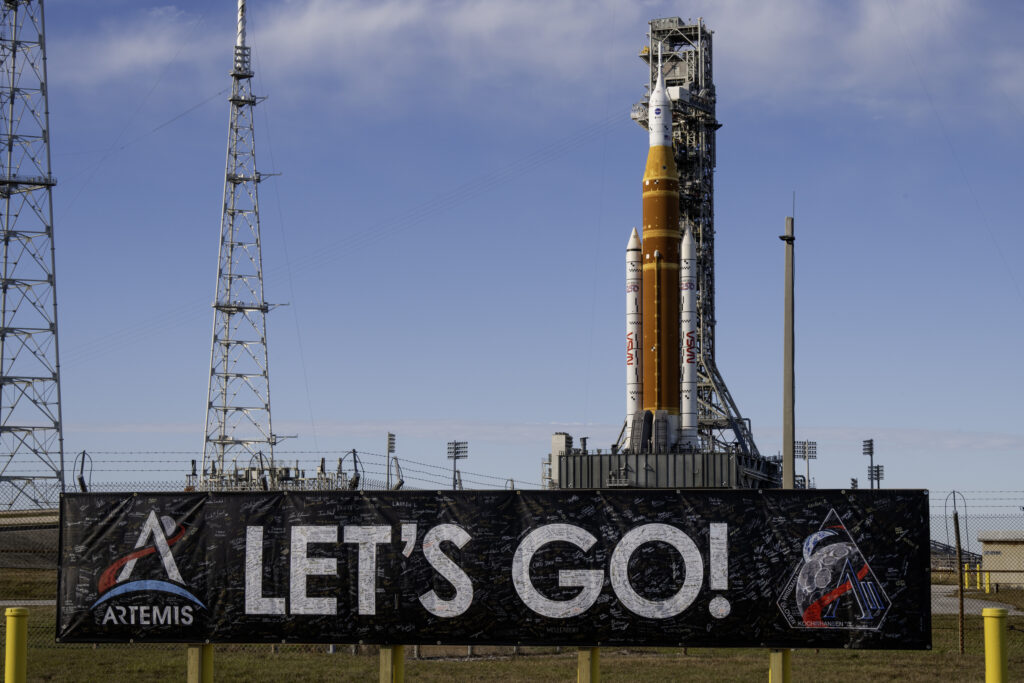
In a race to the moon with China. “One year into President Trump’s second term, and we stand on the precipice of a defining moment for American spaceflight,” posted NASA on X.
“The Artemis program, established during Trump’s first term, is now carrying us into the next chapter of exploration.”
It is also an important part of the critical space race with Communist China, which is advancing several space programs as it pushes for space supremacy.
The space race between China and the U.S. could define whether the 21st century is the Chinese or American century, Colonel Terry Virts, a former NASA astronaut, told Newsweek, warning that China could absolutely beat the U.S. back to the moon.
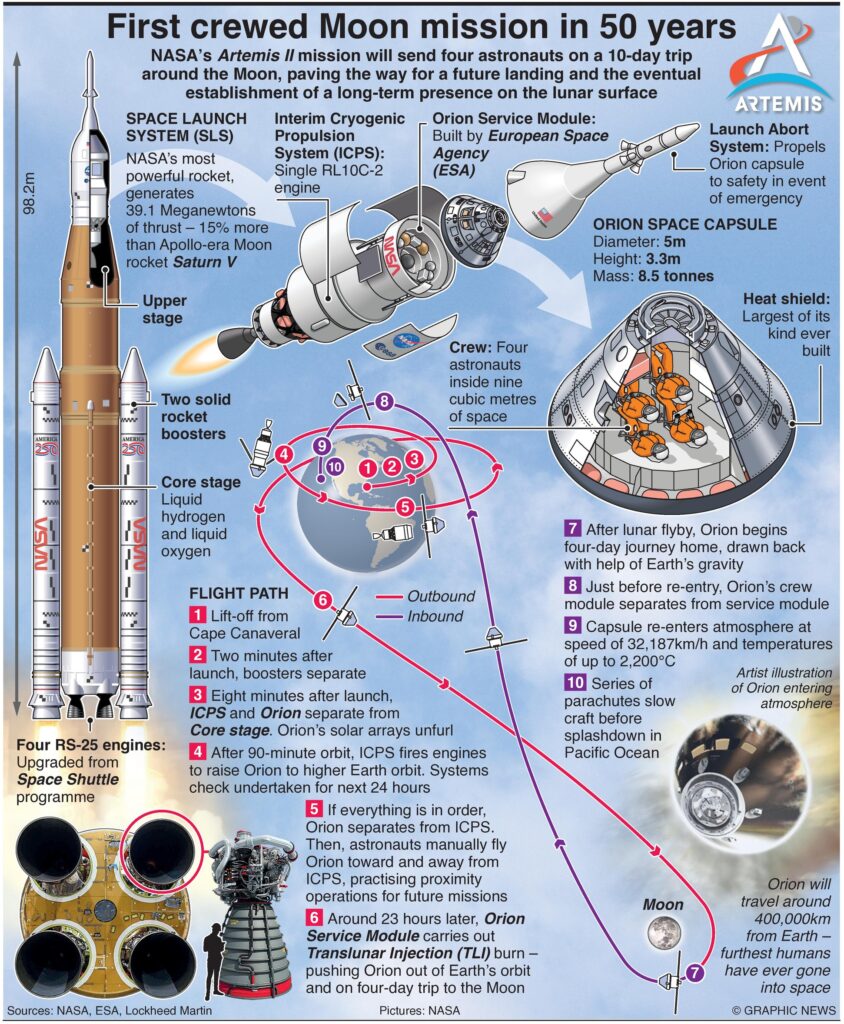
The Artemis II mission, now just days from launch, will send four astronauts on a 10-day flyby trip around the moon, paving the way for a future Artemis III landing and the eventual establishment of a long-term U.S. presence on the lunar surface.
Artemis II is the second mission in the Artemis program and the first crewed flight of NASA’s powerful Space Launch System (SLS) rocket and Orion spacecraft.
The first Artemis mission lasted 25 days and saw the launch of an uncrewed spacecraft in November 2022.
It saw a spacecraft travel around the moon and reenter the Earth’s atmosphere. The mission was overwhelmingly successful, though there were issues with the heat shield on reentry into the Earth’s atmosphere. These have since been addressed.

NASA’s Reid Wiseman, Victor Glover and Christina Koch, along with Canadian Space Agency astronaut Jeremy Hansen – will travel beyond low Earth orbit and loop around the moon before returning to Earth.
The inclusion of a Canadian astronaut reflects Canada’s long-term partnership with NASA through the Artemis program, including its commitment to provide Canadarm3, a robotic arm for the future Gateway space station that will orbit the moon.
While the crew will not land on the lunar surface, they will become the first humans to venture that far into space since Apollo 17 in December 1972.
The primary goal of the mission is to thoroughly test the rocket and spacecraft systems in deep space, ensuring they are ready for a future lunar landing later in this decade.
During the mission, astronauts will travel thousands of miles beyond the moon, experience deep-space radiation, and test life-support, navigation and communications systems in real flight conditions.
But the crew will also be human guinea pigs. Experiments will monitor how their bodies are affected by space. To avoid dissecting the astronauts, scientists will grow tissue samples from the astronauts’ blood called organoids both before and after their journey.
The two sets of organoids will then be dissected and compared to see how the astronauts’ bodies have been affected by space.
Artemis II will also deploy four CubeSats, or small satellites, that will be riding inside the rocket’s Orion stage adapter. These CubeSats – provided by countries that are members of the Artemis Accords – will be deployed five hours after launch.
After the spacecraft slingshots past the Moon, the astronauts begin their four-day journey home.
On arrival, after the service module, with the spacecraft’s primary propulsion system, separates from the crew module, the astronauts will then begin a dangerous part of the mission as they reenter the Earth’s atmosphere, and parachute back to the surface of the ocean off the coast of California.
The outcome of Artemis II will directly influence the timeline for Artemis III, the mission intended to return American astronauts to the Moon no earlier than 2027.
But even if this mission goes perfectly, the agency’s stated aim of “no earlier than mid-2027” for Artemis III is unrealistic, according to Dr. Simeon Barber of the Open University.
“The moon landing will require [Elon Musk’s] SpaceX Starship to take the astronauts to and from the surface, and we’ve seen in recent months that Starship itself still has a long way to go before it can even achieve an orbital flight around the Earth, let alone put astronauts on board.”
These and other factors, including FAA approval, may push Artemis III landing into 2028 or 2029. This means the U.S. will be cutting it close to return to the Moon before China lands there for the first time.
China expects to send its astronauts, known as “taikonauts,” to the lunar surface before 2030.
The opinions expressed in this article are those of the author and do not necessarily reflect the positions of American Liberty News.
READ NEXT: Courtroom Bombshell Rocks Alleged Assassination Case
Sponsored
CHIP IN $26 NOW to lock in Founder Status and join me on the frontline! Your support at this critical moment helps fight with Trump and fuel the grassroots movement that’s defending America’s future. FIGHT WITH TRUMP — JOIN THE FRONTLINE and stand with patriots like you.



















Space the Canadian.
Well, they faked one moon landing over 50 years ago, and hardly anyone knows about that….So I guess it is time to waste billions of dollars of scarce funds to have another go at it! After all, that’s what people of integrity do with other peoples’ money!!
“These and other factors, including FAA approval, may push Artemis III landing into 2028 or 2029. This means the U.S. will be cutting it close to return to the Moon before China lands there for the first time.
China expects to send its astronauts, known as “taikonauts,” to the lunar surface before 2030.”
And yet, China has little or no more assurance that they will meet that date, either.
That first “moon landing ” was totally faked. I’m assuming that that is the plan again… Quite a way to waste our scarce taxpayer dollars!!!