





Via Bulgarian Military by Boyko Nikolov
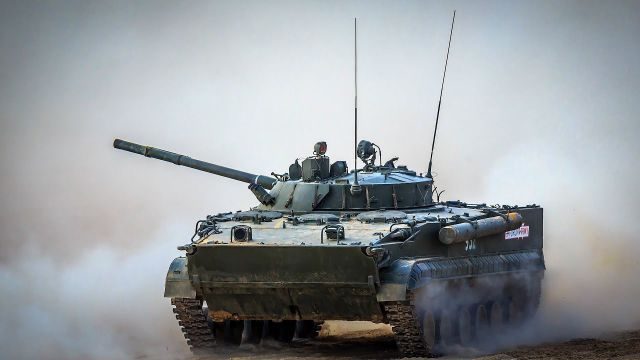
Russia’s military has taken delivery of its first batch of 2025 BMP-3 infantry fighting
vehicles, as announced by Rostec in a press release from its subsidiary, Kurganmashzavod. The delivery marks the continued modernization of Russia’s mechanized forces.
- US clears major upgrade for Egypt’s four fast missile craft
- Boeing’s AH-64E Apache delivery to India hits limbo again
- Brazil’s Gripen shows off Meteor & IRIS-T in elusive flight
“The latest vehicles are equipped with advanced defensive systems, tested in real combat conditions,” stated Rostec. “The equipment has undergone a full testing cycle before deployment.”
Though the announcement was made on February 5, the exact date of delivery remains unclear, along with the number of units in the batch. Traditionally, such deliveries include dozens of BMP-3s, with quantities typically ranging between 10 and 20 units per batch.
The Russian BMP-3 is an infantry fighting vehicle [IFV] that has established itself as one of the most powerful and versatile in its class. Development of the BMP-3 began in the 1980s by the design bureau of Kurganmashzavod in Kurgan, Russia, to replace older models like the BMP-1 and BMP-2. This IFV entered service in 1987 and is known for its high firepower, mobility, and amphibious capabilities.
The BMP-3 is armed with a primary weapon suite that includes a 100mm semi-automatic cannon 2A70, capable of firing both high-explosive and anti-tank rounds, paired with a 30mm automatic cannon 2A72 and a coaxial 7.62mm machine gun PKT.
This arsenal allows the BMP-3 to deal with various targets on the battlefield, including armored vehicles, fortifications, and personnel. It can also fire the 9M117 “Bastion” (AT-10 Stabber) anti-tank missiles from its guns, providing additional capability to combat heavier armored vehicles.
Modifications of the BMP-3 are numerous and tailored for different operational needs. One of the early modifications is the BMP-3 MICV, an export version equipped with a Thompson-CSF thermal sight and other imported equipment, designed for countries like the UAE from 1998 onwards.
The BMP-3M is an upgraded version of the base model with new weaponry and engine systems. It includes an advanced fire control system with a digital computer, upgraded sights for the gunners, and the ability to fire laser-guided munitions. The UTD-32 engine in the BMP-3M delivers 660 horsepower, enhancing the vehicle’s mobility and speed.
Other modifications include the BMP-3F, specifically designed for marine infantry with improved buoyancy and stability for operations in marine environments; the BMP-3K, the command version with additional communication equipment for tactical management; and the BMP-3K “Rys” [Lynx], intended for reconnaissance operations.
There’s also the BMMP, a version for the naval infantry with a BMP-2 turret, and the BREM-L “Beglianka,” an armored vehicle for evacuation and repair.
Recent developments include the BMP-3M Manul, introduced in 2022, which is a fully modernized variant with the unmanned Bumerang-BM turret, increasing the space for troops due to the absence of a manned turret. This model is expected to replace older models in the Russian military, offering greater firepower and protection.
The BMP-3 is in service with several countries besides Russia, including the United Arab Emirates, Kuwait, Indonesia, Iraq, and South Korea, which speaks to its reliability and popularity on the international arms market.
Despite initial criticisms in the early 2000s regarding troop safety, with soldiers preferring to ride on top of the vehicle rather than inside, recent modifications and upgrades have focused on improving crew protection and comfort.
The BMP-3 has seen extensive combat experience and has become a significant player on the international arms market. Its combat history is as diverse as the terrains it has operated in. In the Chechen conflicts, the BMP-3 was praised for its firepower and mobility, although it faced criticism for crew protection, leading to modifications in subsequent models.
The vehicle’s performance in urban warfare highlighted both its strengths and the need for adaptations to counter threats like RPGs and IEDs. In Syria, where Russian forces intervened, the BMP-3 proved its worth not only in direct combat but also in providing mobile fire support to infantry, showcasing its versatile armament which includes a 100mm gun capable of firing both conventional shells and anti-tank missiles, alongside a 30mm cannon.
Internationally, the BMP-3 has made its mark through strategic exports. One of the earliest and most significant buyers was the United Arab Emirates [UAE], which acquired hundreds of these vehicles in the early 1990s. The BMP-3 was modified for the UAE’s specific climatic and operational requirements, including the addition of advanced thermal sights.
This deal was pivotal, signaling Russia’s ability to compete with Western arms suppliers in the Middle East. The UAE’s continued interest in upgrading their BMP-3 fleet to the BMP-3M standard in 2011, with a contract worth $74 million, underscores the vehicle’s lasting appeal.
Kuwait followed suit, purchasing BMP-3s to bolster its armored forces, reflecting trust in this Russian-made IFV’s capabilities. South Korea, typically reliant on Western technology, also chose to include BMP-3s in its arsenal, adapting them for its unique operational environment. Indonesia’s purchase of BMP-3F, a version optimized for marine operations, indicates the global recognition of the BMP-3’s amphibious capabilities.
The BMP-3’s export story also includes nations like Cyprus, Sri Lanka, and Venezuela, expanding its footprint across different continents. Each sale often came with modifications tailored to the buyer’s needs, showing Russia’s adaptability in the international arms market. Iraq, for instance, ordered 300 BMP-3s in 2015, aiming to modernize its forces against the backdrop of regional conflicts.
These international sales have not been without geopolitical implications. Each deal with countries like Saudi Arabia, which considered substantial purchases, or with nations in Southeast Asia, positions Russia as a key player in global military diplomacy, often competing or collaborating with other arms exporters like the United States, France, and China. The BMP-3 has thus become more than just a piece of military hardware; it’s a symbol of Russian military technology’s reach and influence on the world stage.
However, the export journey of the BMP-3 has also faced challenges, including Western sanctions affecting Russia’s ability to secure deals and deliver on time. Despite these hurdles, the BMP-3 continues to be a sought-after vehicle, demonstrating its combat effectiveness and the enduring legacy of Soviet and Russian armored vehicle design in modern warfare.
Read in its entirety at bulgarianmilitary.com.
READ NEXT: Trump Strikes Back: Controversial Fauci Tribute Sparks Furious Response



















Fresh drone bait.