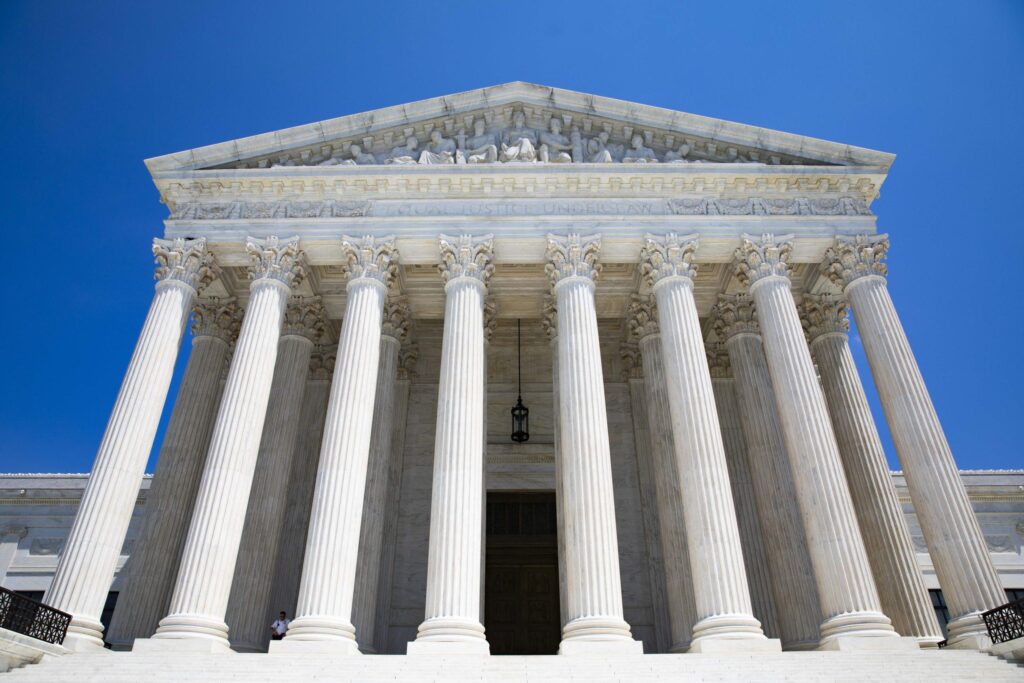
The U.S. Supreme Court on Monday cleared the way for Alabama Republicans to move forward with a controversial new congressional voting map, marking another major development in the ongoing national battle over redistricting and voting rights.
The decision allows Alabama officials to pursue a congressional map that would likely reduce the number of Black-majority or near-Black-majority districts in the state from two to one. The ruling comes amid broader legal and political disputes surrounding the Voting Rights Act and congressional district boundaries ahead of the 2026 midterm elections.
Legal experts say the case could have significant implications not only for Alabama but also for several other states currently reconsidering congressional maps after recent Supreme Court decisions affecting minority voting protections.
The latest action by the Supreme Court follows an earlier ruling that weakened key portions of the Voting Rights Act, triggering renewed efforts by Republican-led states to redraw districts in ways they argue comply with constitutional standards while critics claim could dilute minority voting power.
The U.S. Supreme Court has vacated a lower court ruling requiring Alabama to maintain two majority-Black congressional districts in a 6-3 decision.
— VoteHub (@VoteHub) May 11, 2026
The ruling allows Alabama to revisit its congressional map ahead of 2026 and could lead to a more Republican-leaning configuration.
The Alabama redistricting battle has been unfolding for several years.
Following the 2020 Census, Alabama’s Republican-controlled legislature approved a congressional map containing only one majority-Black district out of the state’s seven congressional districts, despite Black residents making up roughly 27% of Alabama’s population.
Civil rights groups and Black voters challenged the map in federal court, arguing it violated Section 2 of the Voting Rights Act by diluting Black voting strength.
In 2023, the Supreme Court surprised many court observers when it ruled in favor of Black voters in the case commonly known as Allen v. Milligan. That ruling required Alabama to create a second district in which Black voters either constituted a majority or had a meaningful opportunity to elect candidates of their choice.
A court-ordered map was subsequently adopted, resulting in the election of two Black Democratic members of Congress from Alabama.
However, the legal landscape shifted dramatically in 2026 after the Supreme Court issued another major ruling involving Louisiana’s congressional map. That decision narrowed the interpretation of protections under the Voting Rights Act and prompted Republican officials in several Southern states to revisit congressional district boundaries.
As The Hill reports:
The action in Alabama follows the Supreme Court’s blockbuster Voting Rights Act decision. The 6-3 ruling, which involved Louisiana’s map, narrowed a key tool groups have used for decades to force additional majority-minority districts.
As it paves the way for Louisiana Republicans to remove their second-majority Black district for the midterms, Alabama Republicans are hoping for a similar opportunity.
Republicans currently view redistricting as a key strategy for strengthening their congressional advantage before the 2026 elections. Analysts say Alabama’s revised map could increase Republican chances of gaining another congressional seat if the GOP-backed districts remain in effect.
The issue is especially important because control of Congress remains narrowly divided nationally.
This is a breaking news story. Please check back for updates.
READ NEXT: The Sophisticated Criminal Operation That Targeted Tucker Carlson