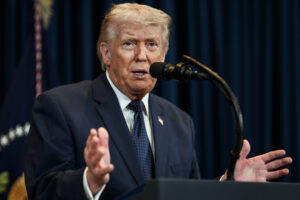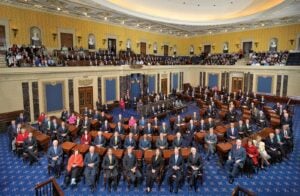

President Donald Trump said Tuesday that he wants Supreme Court Associate Justices Samuel Alito and Clarence Thomas to remain on the bench, dismissing the suggestion that he might prefer one of them to retire so he could appoint a younger conservative justice.
During an interview on Politico’s The Conversation, White House bureau chief Dasha Burns asked Trump whether he would like to see either Alito, 75, or Thomas, 77, step down before the end of his term.
“Do you want to see one of the justices on the Supreme Court retire so you can put in one more before the end of your term?” Burns asked. “Clarence Thomas is 77. Samuel Alito is 75. Do you want one more on there?”
“Uh, well, I hope they stay ’cause I think they’re fantastic, OK? Both of those men are fantastic,” Trump responded.
Trump also used the interview to warn that some Democrats are pushing to expand the Supreme Court, a move he said would be a “terrible thing” for the country.
During his first term, Trump appointed three justices — Neil Gorsuch, Brett Kavanaugh, and Amy Coney Barrett — securing a conservative majority on the Court. Both Alito and Thomas have issued rulings favorable to Trump in significant cases, including granting him immunity for official acts taken while president and allowing him to deport Venezuelan nationals under the Alien Enemies Act.
The Supreme Court is currently considering a case involving Trump’s executive order seeking to end birthright citizenship for children of illegal immigrants. Trump told Burns that the justices “must rule in the administration’s favor,” arguing that the constitutional clause used to establish birthright citizenship was never intended to apply to the children of wealthy foreign nationals or illegal immigrants.
This follows an executive order issued in January on his first day in office, ending guaranteed citizenship for children born in the United States to illegal aliens or migrants on temporary visas.
The administration urged the Court in September to take up the case after lower courts ruled the order unconstitutional. In its petition, the administration argued that the 14th Amendment’s Citizenship Clause “was adopted to confer citizenship on the newly freed slaves and their children, not on the children of aliens temporarily visiting the United States or of illegal aliens.”
The Court previously confronted the order, though not on its constitutionality. Instead, the question was whether lower courts could issue sweeping nationwide injunctions to block policies like it. In June, the Supreme Court held that such “universal injunctions” likely exceed the authority given to federal courts.
According to the administration, Trump’s order “restores the original meaning” of the Citizenship Clause, which it argues extends only to children who are “completely subject” to the political jurisdiction of the United States. Solicitor General D. John Sauer wrote that early Supreme Court interpretations of the 14th Amendment “explicitly rejected the notion that anyone born in United States territory, no matter the circumstances, is automatically a citizen so long as he is subject to U.S. law.”
Opponents counter that the Supreme Court already addressed this issue in its 1898 ruling in United States v. Wong Kim Ark, which held that the 14th Amendment “affirms the ancient and fundamental rule of citizenship by birth within the territory… including all children here born of resident aliens.” Sauer argued that Wong Kim Ark did not decide the status of children born to illegal aliens or temporary visitors.
The Court has not yet set a date for oral arguments, though they are expected to occur early next year.
READ NEXT: SCOTUS Takes Up Trump Birthright Citizenship Order