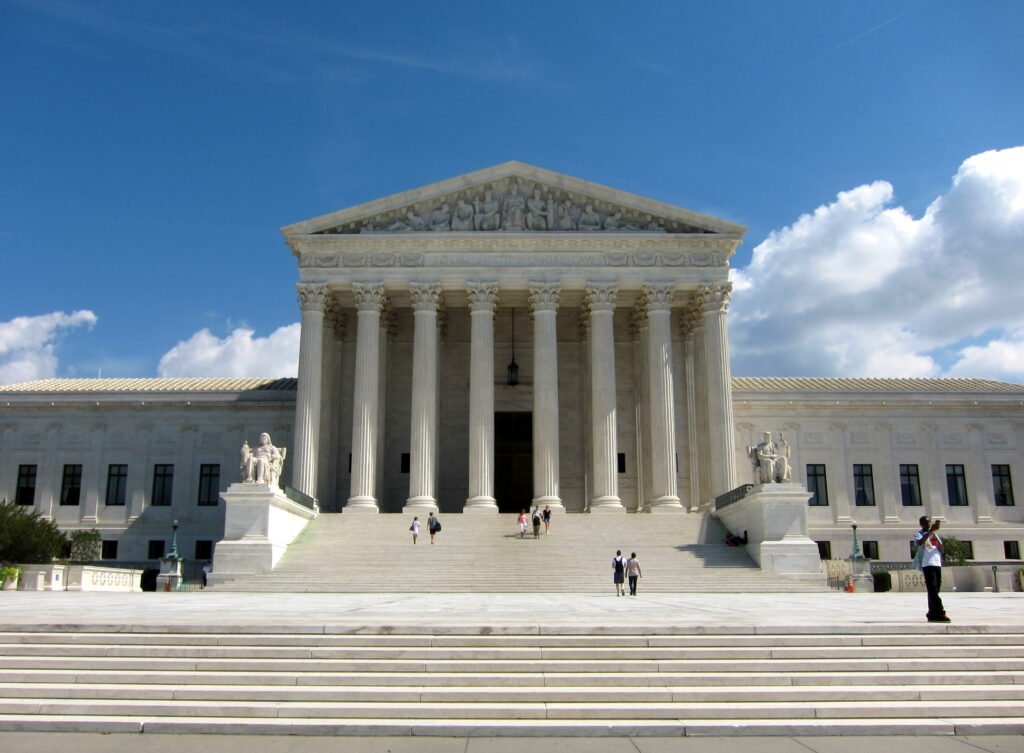
Being a regular user of marijuana is not enough to cost someone their gun rights.
That is the holding the nation’s highest court delivered Thursday morning. In a unanimous ruling, the Supreme Court upheld the Second Amendment rights of a Texas man and admitted regular marijuana user who was found with drugs and a handgun in his home by the FBI. In doing so, the Court at least partially struck down a nearly 60-year-old statute that prohibits addicts or unlawful users of controlled substances from owning firearms.
“But the government’s analogy fails under every measure it asks us to consider: The historical laws on which it relies targeted different kinds of people, did so for different reasons, and operated in different ways,” Justice Neil Gorsuch wrote for the majority in US v. Hemani. “And faced with all these shortcomings in the government’s submission, we cannot say it has carried its conceded burden of showing its prosecution of Mr. Hemani complies with the Second Amendment.”
The ruling delivers a sweeping victory for proponents of both drug policy and gun-rights reform. Though the unanimous Court emphasized that it was delivering a “narrow” ruling, applied only to the particular criminal defendant who challenged federal law, it will nevertheless substantially restrict the government’s ability to bring similar cases moving forward. And in a country in which nearly three-quarters of the population reside in states with some form of state-sanctioned marijuana sales, that could result in a major practical expansion of gun rights.
The case initially concerned the federal government’s attempted prosecution of Ali Danial Hemani under 18 USC § 922(g)(3). Though he was only charged with possessing a firearm in light of his admitted cannabis use, the Justice Department leveled much more serious accusations against Hemani in its legal filings. These included claims that Hemani possessed, used, and sold harder drugs, including cocaine and promethazine, and had alleged ties to affiliates of the Iranian Revolutionary Guard Corps, a designated terrorist organization.
Despite this, a Fifth Circuit Court of Appeals panel tossed his charges under the Second Amendment last January due to its established precedent that regular marijuana use, on its own, does not render someone too dangerous to retain their gun rights. The Justice Department subsequently appealed that decision and intentionally asked for the High Court to take the case before several other pre-existing appeals of weed and guns cases featuring far more sympathetic plaintiffs. The Court agreed to take it up last October.
The Supreme Court heard oral arguments in March, where Hemani’s colorful background did not come up at all. Instead, justices appointed by both parties spent much of the time scrutinizing the sweeping scope of the federal ban and the substances it encumbers. That skepticism was reflected in Thursday’s opinion, particularly as the federal government tried to justify the ban by analogizing to historical laws disarming “habitual drunkards.”
“The government considers Mr. Hemani an unlawful user of a controlled substance because he admits to using marijuana about every other day,” Gorsuch wrote. “But how much marijuana does Mr. Hemani use, in what potency, and to what effect? Is he routinely unable to manage his affairs, a risk to himself or his family? Or does he use a mild gummy as a sleep aid a few times a week? We do not know and, the government says, it doesn’t matter. The government asks us to analogize him to a habitual drunkard all the same.”
The opinion stressed that the government’s logic would apply beyond recreational drugs, like marijuana, to more commonly used prescription medications as well.
“Nor does the government’s theory stop at Mr. Hemani,” Gorsuch added. “It extends equally to a husband who regularly takes his wife’s prescription Ambien to sleep and a college student who routinely uses a friend’s Adderall to cram for exams. The drug involved makes no difference. Nor, again, does it matter how much an individual uses or the effects it has on him.”
Despite delivering a forceful ruling against the government’s attempted prosecution of Hemani, the Court also went out of its way to make clear that it was not invalidating other prohibited persons laws.
“We do not address efforts to ban addicts or those presently intoxicated, from possessing a firearm,” Gorsuch wrote. “We do not address other prophylactic laws Congress might adopt after determining that users of a particular drug pose a special risk of misusing firearms. We do not address 18 U. S. C. §922(g)(1)’s provision disarming individuals convicted of felonies (often including drug-related ones). We do not even address whether the government could bring a prosecution under §922(g)(3) accompanied by individualized proof that the defendant’s use of marijuana (or any other drug) renders him a danger to himself or others. Or proof that a certain drug always renders its users dangerous because of its potency or for some other reason. None of those issues is before us and we do not pass on them either way.”
The unanimous ruling, uniting justices appointed by presidents of both parties, comes despite the way in which the Hemani case blurred typical partisan lines on either side of the legal issue prior to the Court’s decision.
The Trump administration, which has at times gone out of its way to support gun-rights advocates in legal matters and loosen marijuana regulations, defended the constitutionality of the federal gun ban. Joining its position via legal briefs were frequent opponents of the administration, including gun-control organizations like Everytown for Gun Safety and officials representing nearly two dozen Democratic-led states — many of which have legalized marijuana use. On the other hand, Hemani’s position drew support from the National Rifle Association and other gun-rights groups, but also from the American Civil Liberties Union and liberal-leaning drug policy reform organizations.
The justices, meanwhile, did divide into separate camps to pen additional concurring opinions. Justice Clarence Thomas authored a solo concurrence expressing his doubts that the entire drug user gun ban statute, §922(g)(3), could be justified at all under Congress’ interstate commerce powers. Additionally, Justice Ketanji Brown Jackson wrote a concurrence, joined by Justice Sonia Sotomayor, to chastise the Court’s Bruen methodology as “unworkable.” Lastly, Justice Samuel Alito, joined by Justice Elena Kagan, penned a brief concurrence arguing that the Court should have issued a narrower ruling.
“Here, the Government’s analogues are too far afield to justify the application of §922(g) to a marijuana user like respondent,” Alito wrote. “We need not say more to decide this case, and I would for that reason say no more.”
UPDATE 6-18-2026 10:57 AM EASTERN: This piece has been updated with more details from the ruling.
Find this article on The Reload.
READ NEXT: Trump To Hear GOP Shutdown Strategy This Week