





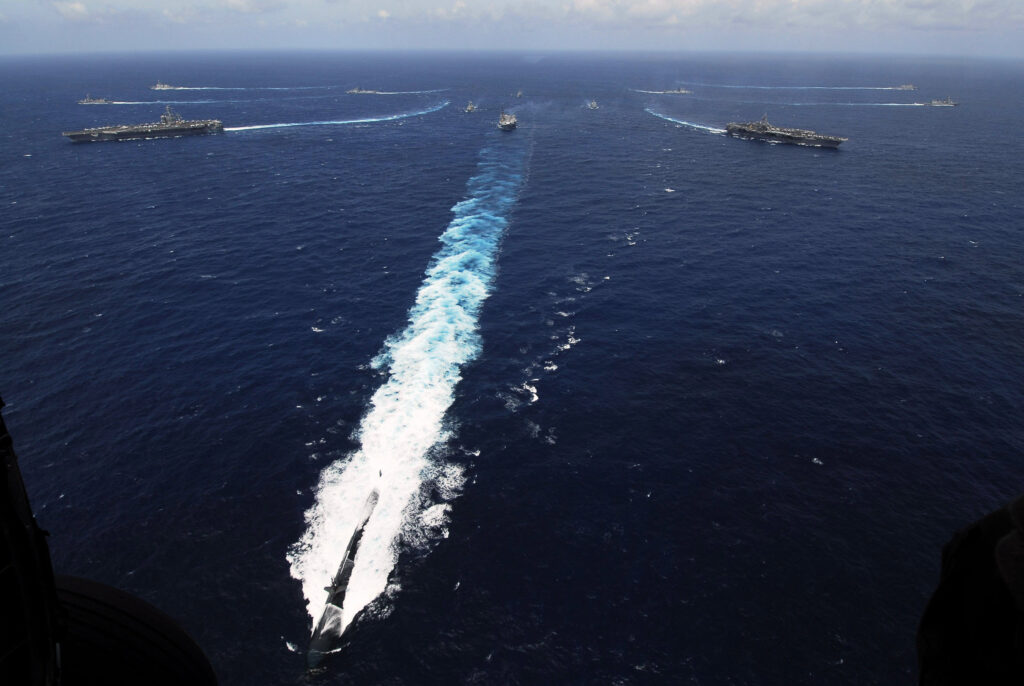
Russian involvement in Venezuela, even as the U.S. expands its military forces nearby and warns of expanding hostilities into the country itself, is making some worry that Team Trump may be risking a wider war, and may even be “sleepwalking into Armageddon.”
Russia’s strategic relationship with socialist Venezuela goes back decades.
I have written extensively about the advanced weapons, especially the number of anti-air and offensive strike missiles Russia has sent to Venezuela’s illegitimate socialist strongman, Nicolás Maduro, and noted they do pose some risk to U.S. forces, especially aircraft and ships.
I’ve also added that the Kremlin seems to be continuing mysterious military airlifts into the country.
The question, though, is how much deeper will Vladimir Putin’s military support for Maduro go? Will he send technicians and troops? Will he draw a red line that he warns the U.S. not to cross?
It is clear Putin would love to see the U.S. bogged down in its own war in Venezuela. But does that mean he would intervene in a way that would escalate a conflict in Venezuela into a U.S.-Russia military clash that could even go nuclear?
While I believe the latter is very unlikely, let’s look at the situation we have.
Diplomatically, Moscow seems to be throwing its weight behind its Venezuelan ally. Russian officials have used strong terms to denounce American actions in the area.
And, just last month, Caracas and Moscow ratified a strategic partnership that had been signed by the two leaders in May.
More recently, Sergey Lavrov, Russia’s long-time foreign minister, insisted the Kremlin was “ready to fully act” in Venezuela’s defense. However, he added that Maduro had not requested military aid and that, according to the terms of their cooperation deal, the Kremlin is under no obligation to defend Venezuela from foreign attack.
Still, Maduro has been playing up his Russia connection. The Atlantic reported that:
In his weekly television show — the Venezuelan president welcomed a question about his foreign allies. He singled out one in particular: Russia.
“We are like this,” he gushed, interlocking his fingers to show the closeness of the bond. “More united than ever.”
As I also noted previously, a senior Russian official even suggested that Moscow could send its latest nuclear-capable Oreshnik intermediate-range ballistic missiles to Caracas. If sent, these weapons could reach U.S. targets throughout the Caribbean and even the southern U.S., essentially creating a new Cuban Missile Crisis in Venezuela.
But Russia has only used that missile once in Ukraine, signaling it may not be as effective as touted, or that Russia simply doesn’t have many of them to spare.
Meanwhile, there are a lot of factors that point to Russian bravado being mostly bluff and bluster. And the Kremlin is unlikely to risk escalation with the U.S. in America’s backyard.
Newsweek noted:
…there will be firm limits that likely will not include troops to augment the military advisers Russia has sent for years, analysts say. Russia is preoccupied fighting the war on its own border and is unlikely to have much to spare for a far-flung ally while it is fending off attacks on its soil.
And of the two, Moscow benefits least from the tether with Caracas. Venezuela has, so far, not requested military assistance or that Russian weapons be deployed in the country, Russian Foreign Minister Sergey Lavrov said on Tuesday.
The strategic partnership agreement is “just a piece of paper,” said John Foreman, a former U.K. defense attaché to Russia and Ukraine. “Given Russian manpower losses in Ukraine, I don’t see Putin sending troops to bail Maduro out.”
As The Atlantic noted:
Indeed, Maduro may be about to learn the same difficult lesson absorbed by the governments of other Russian allies, including Armenia, Syria, and Iran. They all recently appealed to the Kremlin for help only to discover that the war in Ukraine has taken such a toll, and remains such a priority, that Russia’s ability to come to the rescue is severely diminished.
So, while Putin may provide Maduro diplomatic backing, and some weapons, it is unlikely to risk a war with the U.S., especially with Trump in office. That doesn’t mean that Russia won’t help Venezuela at all, beyond sending some weapons.
Newsweek added:
There are other tools in Russia’s hands. While it has little concrete military backing to offer Maduro, it may back a proxy conflict, Sabatini said. That could mean handing over financial support to certain people or funding paramilitary groups, he said, or [provide] a helping hand skirting sanctions.
Note my prior piece that described the Russian Ilyushin Il-76 transport plane formerly operated by the Wagner paramilitary group, which landed mysteriously in Caracas a few weeks ago, before quickly departing. It reportedly carried 50 tons of equipment and maybe personnel.
Russia could help Venezuela fight asymmetrically.
For example, if U.S. forces attempted to land onshore, Russian low-cost drones could be used to attack and harass them, a deadly tactic both sides have employed in Ukraine.
Newsweek noted that, “Putin and his generals may see turning those weapons against the U.S. as poetic justice, given Washington’s support of Kyiv.”
And if U.S. planes or surveillance or strike drones entered Venezuela’s airspace, Russian electronic warfare systems could potentially jam GPS and radio signals, causing chaos.
Putin is an expert in deniable hybrid warfare in the gray zone. And that’s the Russian involvement that may occur. We must be prepared for the unexpected.













Russia cannot even handle the Ukraine. They may be being paid to keep us busy while China attacks Taiwan though.