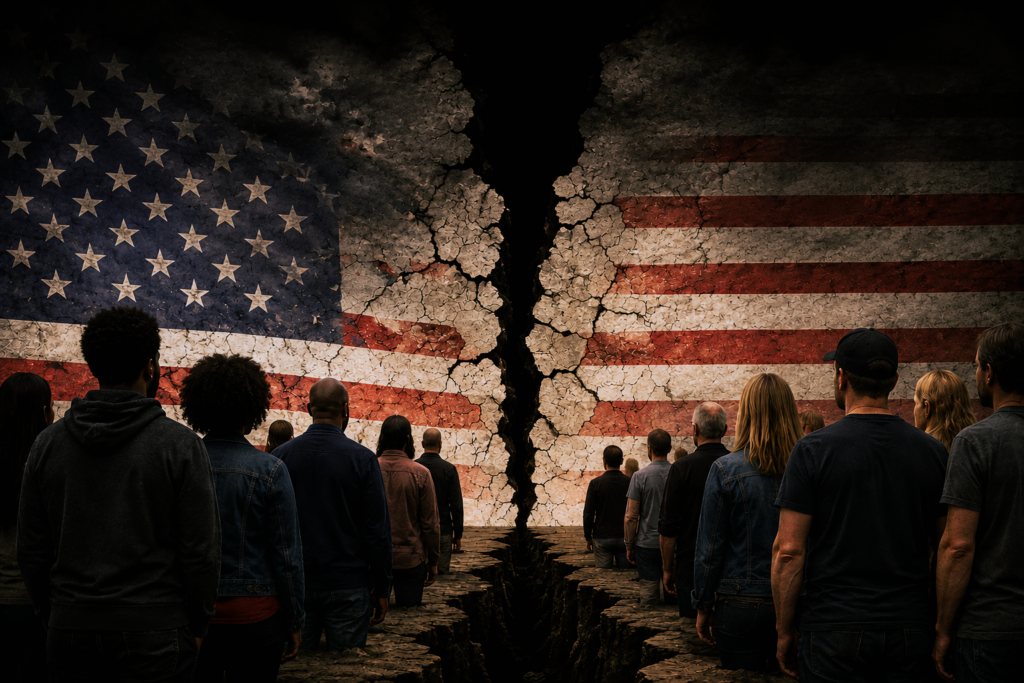
Begin with a simple picture, because the law in this case is finally as simple as the picture. Two families lived on the same Evanston street in 1955. They shared a fence, a school district, and very likely a set of grievances against the city that zoned and policed them. Today the city of Evanston will write one of those families a check for $25,000 and turn the other away at the door. The families are identical in every particular the law has ever cared about, with one exception. One family is Black and the other is not. That single fact, and nothing else, decides who is paid and who is refused.
When a government sorts its citizens that way, it is doing the precise thing the 14th Amendment was ratified to forbid. This is the heart of the matter, and it is worth stating plainly before the lawyerly fog rolls in. The Equal Protection Clause protects persons, not races. It was written after a war fought over racial caste, and it was written to abolish caste, not to license a friendlier version of it. A program that pays citizens according to the color of their skin, or the color of their parents’ and grandparents’ skin, does not repair the old hierarchy. It rebuilds it with the beneficiaries rearranged.
Evanston’s “first in the nation” reparations program is discriminatory and illegal. @CivilRights sued the city today challenging the program. ⁰⁰Other cities are on notice: discriminate against residents — you’ll hear from us!https://t.co/1KgfQM02l1
On June 16, the Department of Justice said so, formally and on the record. Assistant Attorney General Harmeet Dhillon, who leads the Civil Rights Division, moved to intervene in the lawsuit against Evanston’s program and put the point with a clarity that the courts have spent 30 years approaching. There are sound ways for a city to help its poorest neighborhoods, she said, but simply handing out money based on race is not the answer. It is race discrimination, pure and simple, and it is illegal. That is the government of the United States adopting as its litigating position what an honest reading of the Constitution has required all along. Dhillon deserves credit for it. For decades the federal civil rights apparatus enforced the colorblind command in one direction only, against discrimination that injured minorities, while averting its eyes from racial sorting dressed up as benevolence. To enforce the rule evenhandedly, against a city that discriminates by race for reasons it calls noble, is not a betrayal of the civil rights tradition. It is the fulfillment of it.
Consider the doctrine the city must overcome, because it is not some recent conservative invention. The Supreme Court has held for more than three decades that every racial classification by government, at every level, must survive strict scrutiny, the most demanding test in constitutional law. In City of Richmond v. J.A. Croson Co., decided 6 to 3 in 1989 and written by Justice Sandra Day O’Connor, the Court struck down a minority contracting set-aside in a majority-Black city governed by a majority-Black council. Richmond had a real statistical disparity to point to, minority firms receiving under 1% of contracts in a city half-Black, and the Court still said no. General societal discrimination, however genuine, cannot justify a racial remedy. The government must identify a specific instance of unlawful discrimination and tailor the remedy narrowly to it. O’Connor warned that the alternative was a future in which the dream of a nation of equal citizens would dissolve into a mosaic of shifting preferences based on inherently unmeasurable claims of past wrongs. That sentence reads today like a prophecy of Evanston.
The Court only sharpened the rule afterward. Adarand Constructors v. Peña in 1995 closed the supposed loophole for federal programs and applied strict scrutiny to every level of government. Students for Fair Admissions v. Harvard in 2023, again 6 to 3, ended race-conscious admissions and reminded the country that distinctions drawn solely by ancestry are odious to a free people. Then, just this past April, the Court decided Louisiana v. Callais, a 6 to 3 opinion by Justice Alito holding that a congressional map could not use race as its organizing principle absent a compelling justification the state did not have. Callais matters here for a reason that has nothing to do with voting maps. It restated, in the freshest possible terms, the two conditions any remedial racial classification must meet. The government must identify the specific past discrimination and the precise scope of the injury, and it must possess a strong basis in evidence that the race-based remedy is necessary. And it reaffirmed the disqualifier directly. There is no compelling interest in generally remedying the effects of societal discrimination across a region or an era. A century-old, generalized grievance is entitled, in the Court’s words, to much less weight. One struggles to imagine a sentence more precisely fitted to Evanston’s case if it had been drafted for the occasion.
Here a careful reader will pause and ask the natural question. Surely Evanston has done its homework. Surely a city would not stake millions of dollars and its moral reputation on a program without first identifying the specific discrimination it claims to remedy. The honest answer, drawn from the federal complaint and from the city’s own documents, is that it did not. The enabling resolutions contain only boilerplate acknowledging harm to Black residents. They identify no specific unlawful act, name no precise injury, and rest on no strong basis in evidence. The city’s own policy report, the nearest thing to a factual foundation, is a working document whose authors expressly declared themselves neutral and disclaimed any responsibility for how it would be used. A government does not build a constitutional defense on a paper its own authors refuse to stand behind.
It is worse than an absence of proof. While the program was being written, former White House Counsel C. Boyden Gray submitted a detailed warning that it would be unconstitutional and that the city had given only perfunctory thought to race-neutral options like income-based housing aid. The city adopted the program unchanged. Later, when officials added the unrestricted cash payment, the city’s own Corporation Counsel conceded on the record that they did not have the research to show a cash benefit would be a narrowly tailored remedy. The defendant’s own lawyer admitted the fatal flaw before the plaintiffs ever had to prove it. And the program’s nominal escape hatch, a provision for people who can document post-1969 housing discrimination, turns out to be gated by race as well, because such claimants must first submit proof of race and then wait until every race-qualified ancestor and descendant has been paid. The fig leaf is itself a racial classification.
Look at the mechanics and the figures, which the city funds, fittingly, from its cannabis tax. Eligibility runs entirely on bloodline. An ancestor is a Black adult who lived in Evanston between 1919 and 1969, and a direct descendant is that person’s child, grandchild, or great-grandchild. The city has paid at least 141 ancestors a total of $3.525 million, identified at least 454 descendants for payment, distributed well over $5 million already, and would owe more than $11 million to the descendants alone, against a $10 million pledge it has effectively blown past. Now widen the lens, because Evanston is a pilot, not an endpoint. California’s reparations task force, drawing on its own economists, priced a statewide program at figures reaching $800 billion, more than 2.5 times the state’s entire annual budget, with per-person estimates running past $1 million. Those are not a critic’s numbers. They are the proponents’ own arithmetic, and they vindicate O’Connor’s warning that once race becomes the measure of who gets paid there is no logical stopping point and no end date.
The deepest objection is not fiscal. A nation is held together by a shared idea of who its members are to one another. The American idea, the one Justice Harlan defended alone in 1896 when he wrote that our Constitution is colorblind and tolerates no classes among citizens, is that we meet the state as individuals, equal before the law, and not as delegates of our ancestry. Reparations by race quietly replaces that idea with another. It tells citizens that their standing before the government is fixed by descent, that the relevant fact about a man is the color of his great-grandfather, and that public money flows along the channels of blood. Whatever its authors intend, the program teaches the citizenry to see one another as members of racial classes with competing claims on the treasury. That is not repair. It is the manufacture of division, the conversion of neighbors into rival castes, and it is precisely the hierarchy the Equal Protection Clause exists to dismantle.
Chief Justice Roberts gave us the rule in a single unforgettable line. The way to stop discrimination on the basis of race is to stop discriminating on the basis of race. The conservative legal tradition, from Heritage to Cato to the Pacific Legal Foundation, has insisted on this for a generation, not as a partisan slogan but as the plain command of equal citizenship. Two-thirds of Americans agree, including majorities in deep-blue California. Evanston placed itself on the wrong side of the Constitution, the wrong side of the Court, and the wrong side of the public. The Justice Department has now placed the United States on the right side of all three. That is worth celebrating, and it is worth defending until the last race-keyed check is voided.
Sponsored by the John Milton Freedom Foundation, a nonprofit dedicated to helping independent journalists overcome formidable challenges in today’s media landscape and bring crucial stories to you.
Alexander Muse has been delivering sharp conservative headlines and opinion editorials using the amuse on π handle since 2007. His in-depth political analysis is available here through American Liberty. His work is read in the White House, the halls of Congress, on K Street, and by prominent Americans, including Elon Musk, Joe Rogan, and Donald Trump Jr. Ranked among the top 200 most-followed Premium π accounts, his content drives over four billion impressions annually. Follow him on π https://x.com/amuse.
Federal officials have confirmed the first case of New World screwworm in Texas in
At American Liberty News, we eschew the mainstream mediaβs tightly controlled narrative to provide our readers with realΒ news,Β real insights, and the means to take action. We seek out insightful coverage β and partner with knowledgeable and experienced people and organizations to bring you the information and insight our readers demand.
Β
We humbly seek to provide the tools and information necessary for our readers to decide for themselves what is true and what is right.
Reparations By Race Do Not Repair A Nation. They Divide One.
Begin with a simple picture, because the law in this case is finally as simple as the picture. Two families lived on the same Evanston street in 1955. They shared a fence, a school district, and very likely a set of grievances against the city that zoned and policed them. Today the city of Evanston will write one of those families a check for $25,000 and turn the other away at the door. The families are identical in every particular the law has ever cared about, with one exception. One family is Black and the other is not. That single fact, and nothing else, decides who is paid and who is refused.
When a government sorts its citizens that way, it is doing the precise thing the 14th Amendment was ratified to forbid. This is the heart of the matter, and it is worth stating plainly before the lawyerly fog rolls in. The Equal Protection Clause protects persons, not races. It was written after a war fought over racial caste, and it was written to abolish caste, not to license a friendlier version of it. A program that pays citizens according to the color of their skin, or the color of their parents’ and grandparents’ skin, does not repair the old hierarchy. It rebuilds it with the beneficiaries rearranged.
On June 16, the Department of Justice said so, formally and on the record. Assistant Attorney General Harmeet Dhillon, who leads the Civil Rights Division, moved to intervene in the lawsuit against Evanston’s program and put the point with a clarity that the courts have spent 30 years approaching. There are sound ways for a city to help its poorest neighborhoods, she said, but simply handing out money based on race is not the answer. It is race discrimination, pure and simple, and it is illegal. That is the government of the United States adopting as its litigating position what an honest reading of the Constitution has required all along. Dhillon deserves credit for it. For decades the federal civil rights apparatus enforced the colorblind command in one direction only, against discrimination that injured minorities, while averting its eyes from racial sorting dressed up as benevolence. To enforce the rule evenhandedly, against a city that discriminates by race for reasons it calls noble, is not a betrayal of the civil rights tradition. It is the fulfillment of it.
Consider the doctrine the city must overcome, because it is not some recent conservative invention. The Supreme Court has held for more than three decades that every racial classification by government, at every level, must survive strict scrutiny, the most demanding test in constitutional law. In City of Richmond v. J.A. Croson Co., decided 6 to 3 in 1989 and written by Justice Sandra Day O’Connor, the Court struck down a minority contracting set-aside in a majority-Black city governed by a majority-Black council. Richmond had a real statistical disparity to point to, minority firms receiving under 1% of contracts in a city half-Black, and the Court still said no. General societal discrimination, however genuine, cannot justify a racial remedy. The government must identify a specific instance of unlawful discrimination and tailor the remedy narrowly to it. O’Connor warned that the alternative was a future in which the dream of a nation of equal citizens would dissolve into a mosaic of shifting preferences based on inherently unmeasurable claims of past wrongs. That sentence reads today like a prophecy of Evanston.
The Court only sharpened the rule afterward. Adarand Constructors v. Peña in 1995 closed the supposed loophole for federal programs and applied strict scrutiny to every level of government. Students for Fair Admissions v. Harvard in 2023, again 6 to 3, ended race-conscious admissions and reminded the country that distinctions drawn solely by ancestry are odious to a free people. Then, just this past April, the Court decided Louisiana v. Callais, a 6 to 3 opinion by Justice Alito holding that a congressional map could not use race as its organizing principle absent a compelling justification the state did not have. Callais matters here for a reason that has nothing to do with voting maps. It restated, in the freshest possible terms, the two conditions any remedial racial classification must meet. The government must identify the specific past discrimination and the precise scope of the injury, and it must possess a strong basis in evidence that the race-based remedy is necessary. And it reaffirmed the disqualifier directly. There is no compelling interest in generally remedying the effects of societal discrimination across a region or an era. A century-old, generalized grievance is entitled, in the Court’s words, to much less weight. One struggles to imagine a sentence more precisely fitted to Evanston’s case if it had been drafted for the occasion.
Here a careful reader will pause and ask the natural question. Surely Evanston has done its homework. Surely a city would not stake millions of dollars and its moral reputation on a program without first identifying the specific discrimination it claims to remedy. The honest answer, drawn from the federal complaint and from the city’s own documents, is that it did not. The enabling resolutions contain only boilerplate acknowledging harm to Black residents. They identify no specific unlawful act, name no precise injury, and rest on no strong basis in evidence. The city’s own policy report, the nearest thing to a factual foundation, is a working document whose authors expressly declared themselves neutral and disclaimed any responsibility for how it would be used. A government does not build a constitutional defense on a paper its own authors refuse to stand behind.
It is worse than an absence of proof. While the program was being written, former White House Counsel C. Boyden Gray submitted a detailed warning that it would be unconstitutional and that the city had given only perfunctory thought to race-neutral options like income-based housing aid. The city adopted the program unchanged. Later, when officials added the unrestricted cash payment, the city’s own Corporation Counsel conceded on the record that they did not have the research to show a cash benefit would be a narrowly tailored remedy. The defendant’s own lawyer admitted the fatal flaw before the plaintiffs ever had to prove it. And the program’s nominal escape hatch, a provision for people who can document post-1969 housing discrimination, turns out to be gated by race as well, because such claimants must first submit proof of race and then wait until every race-qualified ancestor and descendant has been paid. The fig leaf is itself a racial classification.
Look at the mechanics and the figures, which the city funds, fittingly, from its cannabis tax. Eligibility runs entirely on bloodline. An ancestor is a Black adult who lived in Evanston between 1919 and 1969, and a direct descendant is that person’s child, grandchild, or great-grandchild. The city has paid at least 141 ancestors a total of $3.525 million, identified at least 454 descendants for payment, distributed well over $5 million already, and would owe more than $11 million to the descendants alone, against a $10 million pledge it has effectively blown past. Now widen the lens, because Evanston is a pilot, not an endpoint. California’s reparations task force, drawing on its own economists, priced a statewide program at figures reaching $800 billion, more than 2.5 times the state’s entire annual budget, with per-person estimates running past $1 million. Those are not a critic’s numbers. They are the proponents’ own arithmetic, and they vindicate O’Connor’s warning that once race becomes the measure of who gets paid there is no logical stopping point and no end date.
The deepest objection is not fiscal. A nation is held together by a shared idea of who its members are to one another. The American idea, the one Justice Harlan defended alone in 1896 when he wrote that our Constitution is colorblind and tolerates no classes among citizens, is that we meet the state as individuals, equal before the law, and not as delegates of our ancestry. Reparations by race quietly replaces that idea with another. It tells citizens that their standing before the government is fixed by descent, that the relevant fact about a man is the color of his great-grandfather, and that public money flows along the channels of blood. Whatever its authors intend, the program teaches the citizenry to see one another as members of racial classes with competing claims on the treasury. That is not repair. It is the manufacture of division, the conversion of neighbors into rival castes, and it is precisely the hierarchy the Equal Protection Clause exists to dismantle.
Chief Justice Roberts gave us the rule in a single unforgettable line. The way to stop discrimination on the basis of race is to stop discriminating on the basis of race. The conservative legal tradition, from Heritage to Cato to the Pacific Legal Foundation, has insisted on this for a generation, not as a partisan slogan but as the plain command of equal citizenship. Two-thirds of Americans agree, including majorities in deep-blue California. Evanston placed itself on the wrong side of the Constitution, the wrong side of the Court, and the wrong side of the public. The Justice Department has now placed the United States on the right side of all three. That is worth celebrating, and it is worth defending until the last race-keyed check is voided.
If you enjoy my work, please subscribe https://x.com/amuse/creator-subscriptions/subscribe.
Sponsored by the John Milton Freedom Foundation, a nonprofit dedicated to helping independent journalists overcome formidable challenges in today’s media landscape and bring crucial stories to you.
READ NEXT: Hollywood Revisits Jan. 6 With New Capitol Riot Film

Sponsored
Stand with Rudy Giuliani. Add your name to “THE PEOPLE’S PARDON” today to drop the charges, protect his freedom, and help us reach our critical citizen goal.Alexander Muse β’ amuse on π
Alexander Muse has been delivering sharp conservative headlines and opinion editorials using the amuse on π handle since 2007. His in-depth political analysis is available here through American Liberty. His work is read in the White House, the halls of Congress, on K Street, and by prominent Americans, including Elon Musk, Joe Rogan, and Donald Trump Jr. Ranked among the top 200 most-followed Premium π accounts, his content drives over four billion impressions annually. Follow him on π https://x.com/amuse.
Search
follow us
subscribe
TRENDING STORIES
The Left’s UFC Meltdown Was Never About Dignity
Peace Through Subtraction: How Trump Bought The Middle East A Generation And Perhaps A Lasting Peace
Another Major Health Company Agrees To Pay Settlement Over Minor Transitions
Thune Vs. Thune: The Precedent Senate Republicans Are Pretending Not To See To Pass The SAVE Act
SECURITY
‘Neville Trump’: Andy McCarthy Torches White House Over Emerging Iran Deal
Conservative legal commentator and former federal prosecutor Andrew McCarthy is leading a growing backlash
Trump Rebukes Netanyahu, Suggests Syria Should Take Lead Against Hezbollah
President Donald Trump publicly criticized Israeli Prime Minister Benjamin Netanyahu again on Tuesday, arguing
Israel Refuses Lebanon Pullback As Iran Pushes For Asset Release Ahead Of Final Talks
The fragile U.S.-Iran peace effort appeared to advance Monday, but major disputes remain unresolved
Trump’s Birthday Includes Profanity-Laced Rebuke Of Netanyahu
President Donald Trump marked his 80th birthday Sunday with a blunt and unusually public
FOREIGN AFFAIRS
‘Neville Trump’: Andy McCarthy Torches White House Over Emerging Iran Deal
Conservative legal commentator and former federal prosecutor Andrew McCarthy is leading a growing backlash
Trump Rebukes Netanyahu, Suggests Syria Should Take Lead Against Hezbollah
President Donald Trump publicly criticized Israeli Prime Minister Benjamin Netanyahu again on Tuesday, arguing
Obama Chimes In With His Prediction For Trumpβs IranΒ Deal
Former President Barack Obama is weighing in on President Donald Trump’s newly announced agreement
Critics Say UK Government’s Migration Monitoring Unit Resembles ‘Thought Police’
A British government program designed to monitor online discussions about immigration is drawing sharp
BUSINESS & ECONOMICS
Trump Threatens 100% Tariff On French Wine Over Digital Tax Dispute
President Donald Trump has warned France that it could face a fresh trade battle
Forbes: Elon Musk Becomes The World’s First Trillionaire
Elon Musk has officially become the world’s first trillionaire following the historic public debut
MTG Torches Trump Economy After Inflation Hits 3-Year High
Former Rep. Marjorie Taylor Greene is escalating her public war with President Donald Trump,
Inflation Hits 3-Year High As Gas Prices Drive Costs Higher
Inflation accelerated again in May, reaching its highest level in three years as rising
HEALTH & SCIENCE
Mitch McConnell Hospitalized, Office Issues Update
Sen. Mitch McConnell was admitted to a Washington-area hospital Sunday morning, according to his
Trump Examined By 22 Medical Specialists, Setting Apparent Record For Sitting Presidents
President Donald Trump was evaluated by 22 medical specialists during his latest physical examination,
Tulsi Gabbard Shares Update On Husband’s Health
Outgoing Director of National Intelligence Tulsi Gabbard shared an encouraging update Thursday on her
USDA Sounds Alarm After Flesh-Eating Parasite Found Inside US Border
Federal officials have confirmed the first case of New World screwworm in Texas in
At American Liberty News, we eschew the mainstream mediaβs tightly controlled narrative to provide our readers with realΒ news,Β real insights, and the means to take action. We seek out insightful coverage β and partner with knowledgeable and experienced people and organizations to bring you the information and insight our readers demand.
Β
We humbly seek to provide the tools and information necessary for our readers to decide for themselves what is true and what is right.
TOP TAGS
TOP CATEGORIES
FEATURES
American Liberty News Β©2024
Evolution Digital Media
1900 Reston Metro Plz
Suite 600
Reston, VA 20190