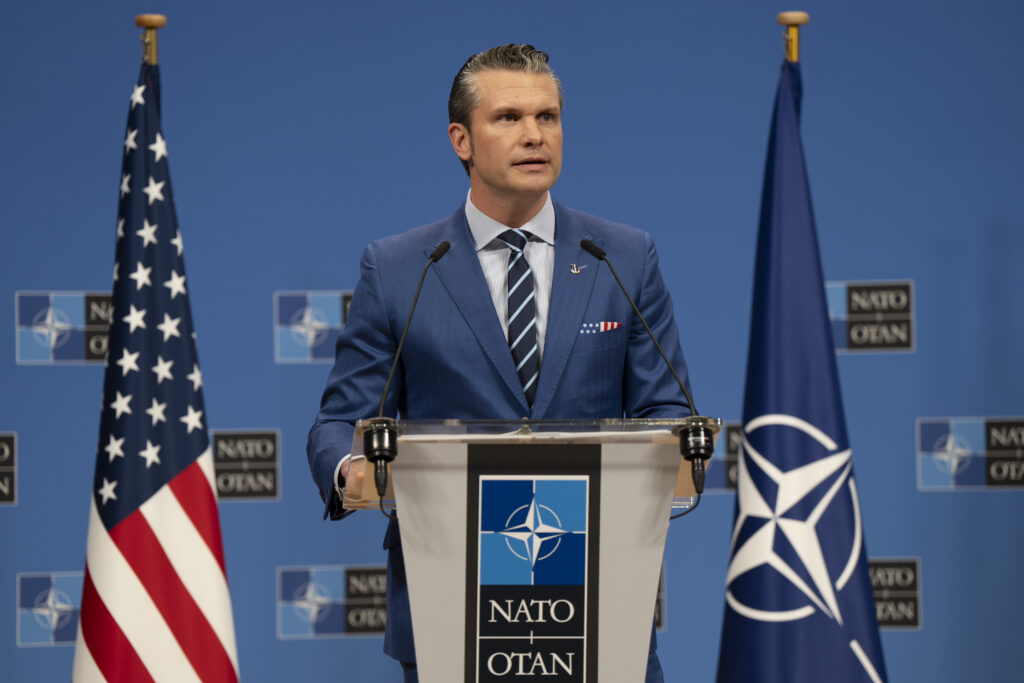
BRUSSELS — Defense Secretary Pete Hegseth sharply criticized NATO allies Thursday while announcing a six-month review of U.S. military deployments across Europe, arguing that the alliance has become a “paper tiger” after decades of underinvestment and dependence on American military power.
Speaking to defense ministers at NATO headquarters in Brussels, Hegseth unveiled what he called a “NATO 3.0 review,” a Pentagon-led assessment of U.S. force posture, basing arrangements, and military commitments across the continent. The review is intended to accelerate a transition toward greater European leadership within the alliance, though Hegseth stopped short of indicating whether it would result in a reduction of U.S. troop levels in Europe.
“What we’re saying is Europe must step up,” Hegseth told ministers, arguing that the alliance can no longer rely overwhelmingly on American military capabilities to guarantee continental security.
The defense secretary said NATO had drifted from its original purpose, describing recent decades as a period marked by deindustrialization, demilitarization, and growing dependence on Washington. He argued that the alliance must return its focus to core defense responsibilities and rebuild military capacity among its European members.
Hegseth also used the Brussels meeting to press allies to dramatically increase defense spending. While NATO’s formal benchmark remains 2% of gross domestic product, he urged member states to maximize military investments and move toward substantially higher spending levels as they assume a greater share of the alliance’s security burden.
Pete Hegseth:
— Clash Report (@clashreport) June 18, 2026
We will lead and exceed our own NATO spending standards.
It's not "do as I say." It's "do as we do." pic.twitter.com/nqSPSnIZsG
His criticism extended beyond defense budgets. Hegseth accused several European governments of publicly questioning recent U.S. actions during the conflict with Iran while failing to provide comparable military support of their own.
Several European countries, including Spain, France, and Italy, declined to make military bases available for U.S. aircraft deploying to the Middle East during the crisis. Hegseth cited those decisions as evidence that NATO allies must do more than offer rhetorical support during periods of international instability.
Pete Hegseth:
— Clash Report (@clashreport) June 18, 2026
We can't live in a world where other countries are standing at the end of a runway with a clipboard trying to decide what flies and what doesn't.
It's not going to work for us. It's not good in contingencies. pic.twitter.com/pzf6dwVS4d
The comments echoed criticism previously voiced by President Donald Trump, who earlier this year also described NATO as a “paper tiger” while faulting European governments for their response to disruptions in global energy markets following the closure of the Strait of Hormuz during the regional conflict involving Iran, Israel, the United States, and Gulf allies.
European officials responded cautiously to Hegseth’s remarks, noting that many NATO members have significantly increased defense spending since Russia’s invasion of Ukraine. At the same time, concerns remain among some allies that any future reduction in the American military presence could weaken the alliance’s deterrence posture.
Pentagon officials emphasized that the six-month review does not predetermine troop reductions and that no final decisions have been made regarding force levels in Europe. Instead, they described the process as a strategic reassessment designed to align American military resources with evolving global security challenges.
The review is expected to conclude later this year and could shape future decisions on U.S. troop deployments, military infrastructure, and NATO commitments across Europe.
READ NEXT: MAGA Kingmaker? Trump Delivers Another GOP Victory