Why Trump’s Strategy Demands A Bigger, Stronger Navy And Marines

Photographer's Mate 3rd Class Jordon R. Beesley, Public domain, via Wikimedia Commons

PAUL’S DEFENSE BRIEF (PDB) – While not specifically saying so, Trump’s new National Security Strategy (NSS) is a clarion call for a larger, more capable Navy. The document’s focus on protection of sea lines of communication, key choke points, and an overall more robust U.S. presence in the Western Hemisphere together point to the need for increasing the size and capability of the Navy.

The Navy currently is composed of approximately 290 ships centered around 11 nuclear aircraft carriers. The responsibilities outlined in the NSS suggest a larger Navy of approximately 350 manned ships and 12 flattops.

The need for expeditionary forces is a key component in the NSS requirements for protection of sea lines of communication and maritime choke points in the Middle East and Indo-Pacific.

The increased military presence in the Western Hemisphere, required by the NSS is fundamentally underpinned by a powerful Navy. Current operations in the Caribbean Sea are enabled by naval forces that provide the president multiple options for kinetic and non-kinetic action.

Grey-hulled Navy and white-hulled U.S. Coast Guard ships are the vanguard of U.S. diplomacy, and a grim harbinger of what happens when nations oppose U.S. efforts. So-called “gunboat” or “big stick” diplomacy does not work absent a large and capable Navy.

The president’s deal for new icebreakers means that the Arctic is another potential location for deployed naval forces where land-based air and ground units are more limited in movement and action.

These new missions mean more amphibious warfare vessels and perhaps modern equivalents of the battleship, probably armed by hypersonic missiles in large numbers.

FOR YOUR EYES ONLY – Here’s a roundup of today’s other top defense news from conservative national security expert PAUL CRESPO.

THE PDB – Not the President’s Daily Briefing, but almost as good – PAUL’S DEFENSE BRIEF:    

NATIONAL SECURITY

Vietnam amends law to ban exports of raw rare earth minerals critical for defense tech, stipulating that only approved companies will be permitted to process and use them.

HOMELAND SECURITY

Federal judge rules Trump administration must stop deploying California National Guard in Los Angeles and return control of troops to state.

HOMELAND DEFENSE

Trump administration adding another militarized zone to southern border to bolster border security — now in California.

Space Force upgrading defenses for Cape Canaveral to counter unmanned aerial systems (UAS) without endangering air traffic.

DEFENSE POLITICS

House passed annual defense policy bill raising troop pay, restricting Trump administration’s ability to reduce U.S. troop levels in Europe and South Korea, providing aid for Ukraine and repealing decades-old laws authorizing military force in Middle East.

Democrat lawmaker blasts Pentagon’s last-minute push to add multiyear munitions package worth “tens of billions of dollars” for FY26 budget.

2026 National Defense Authorization Act would require Pentagon to brief lawmakers on operations since 2004 involving any unidentified anomalous phenomena (UAP) intercepts by integrated military commands that share focus on defending the homeland.

US POWER OVERSEAS

Air Force to conduct more intensive training—and Congress is set to boost funding for exercises and so-called “campaigning” by hundreds of millions of dollars, particularly in Pacific.

VENEZUELA-NARCO THREAT

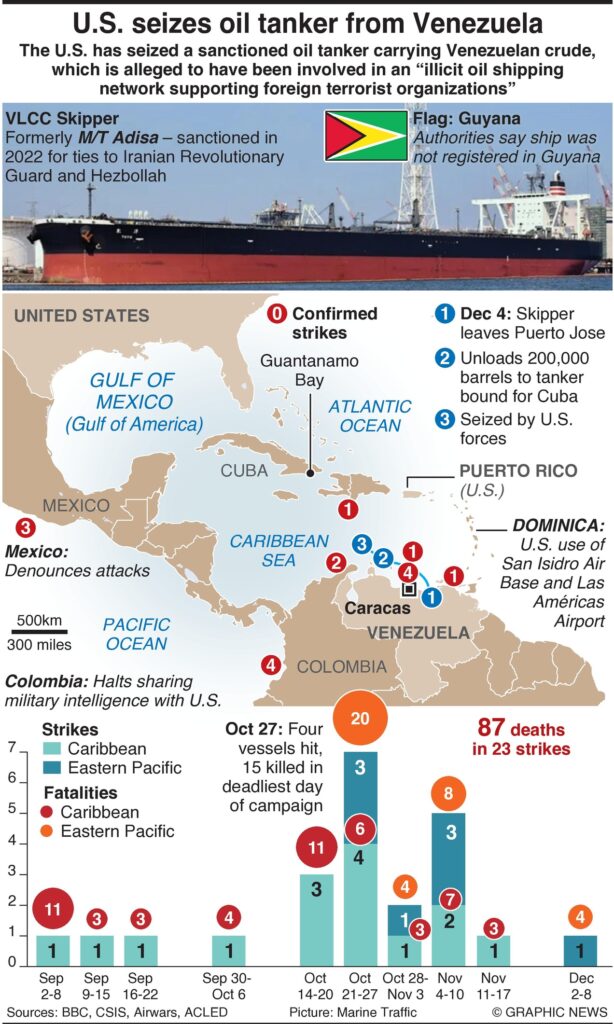
President Trump said U.S. has seized a sanctioned rogue oil tanker off coast of Venezuela as tensions mount with the illegitimate socialist dictatorship of Nicolás Maduro.

Indicator of what’s to come: Six Navy EA-18G Growler electronic warfare jets, roughly full squadron, are now forward-deployed at former Naval Station Roosevelt Roads in Puerto Rico.

CHINA THREAT

New TJS satellite, commercial Kinetica-1 lofts 9 spacecraft launched. China continued surge in launch activity with pair of missions, adding to an opaque satellite series and launching new remote sensing satellites.

South Korean fighters scramble to meet 9 Russian, Chinese aircraft on patrol in its air defense zone.

Now that AUKUS nuke sub pact has officially survived Trump administration review, defense leaders from U.S., UK and Australia reaffirm their commitment to the trilateral deal.

RUSSIA THREAT

U.K. to transform Royal Navy’s submarine-hunting capabilities with hybrid naval force to counter Russian undersea threats in North Atlantic.

Oslo’s clear message to Moscow: Six new U-boats and long-range strike missiles. Norway’s most ambitious reinforcements of its maritime defense capabilities in decades are explicitly framed as direct reaction to intensified Russian military activity in North Atlantic, Barents Sea, Norwegian Sea, and Arctic.

UKRAINE WAR

If true, it’s a big deal.  Volodymyr Zelensky announced that Ukraine has begun using homegrown Sapsan (peregrine falcon) ballistic missiles in combat against Russia.

Additional much-needed MiG-29 Fulcrum fighters are likely headed to Ukraine, with Poland in talks to provide its last remaining examples. Poland already donated 14 MiG-29s to Ukraine. New package should also involve transfer of drone and missile tech from Ukraine to Poland.

Ukrainian forces report unusually large Russian mechanized attack inside strategic eastern city of Pokrovsk, where Russia has reportedly massed force of some 156,000 troops to take the beleaguered and destroyed former logistics hub.

Leaders of “coalition of the willing” group of nations will hold video call about Ukraine war as Trump voiced impatience with European allies and put U.S. involvement in further talks in doubt, saying they risked “wasting time.”

No matter a potential deal to end war in Ukraine, it is unlikely to alter timeline for delivery of Saab Gripen-E fighters to Kyiv.

NATO-EUROPEAN DEFENSE

Denmark labeled U.S. as potential security concern for first time in annual report from one of its intelligence agencies, offering more evidence of increasingly fraught transatlantic alliance between Europe and U.S.

Denmark says no to Patriot: $6.6 billion, buying instead fully European air defense system. In largest arms contract in its history, Denmark will spend $9 billion for 8 ground-to-air defense batteries covering entire spectrum—short, medium, and long range, turning its back on U.S. suppliers for first time.

NATO retains ‘open-door policy.’  Countries looking to join NATO are still welcome to apply, said top alliance official in repudiation of Trump administration’s recent declaration that group must not be “perpetually expanding alliance.”

SPACE THREATS

2026 defense policy bill calls for adding $1.2 billion to Space Force, mostly split between expanding service’s low-Earth orbit (LEO) data transport network and boosting its space-based polar missile warning and tracking.

Blue Origin’s New Glenn rocket will complete four successful orbital flights as its pathway to certification under Space Force’s National Security Space Launch (NSSL) program.

Refueling of satellites in geostationary orbit (GEO) is one of most practical and immediately valuable applications of on-orbit servicing, for national security and commercial uses, requiring focused investment, early demonstrations and coordinated policy work to bring the capability into routine use.

Norway’s Kongsberg and Germany’s Helsing to provide Europe with sovereign satellite constellation for space-based intelligence, surveillance and targeting by end of the decade.

INTERNATIONAL SECURITY

Half million evacuees in Cambodia and Thailand sheltering in pagodas, schools and other safe havens after fleeing fresh border clashes while Trump vowed to intercede to stop the fighting.

US MILITARY

BAE Systems received $322 million order for thousands of laser-guidance kits to go on 2.75-inch rockets Air Force relies on for wide range of combat missions. This, as part of larger $1.7 billion contract.

Navy has selected BAE Systems for five-year contract for tens of thousands of APKWS laser-guidance kits, reinforcing U.S. military’s access to low-cost precision strike capabilities.

Navy wants new frigates based on U.S. design “in the water” in 2028, an aggressive new schedule following service’s cancellation of Constellation-class frigate.

Marines testing Low-Cost Uncrewed Combat Attack System (LUCAS) as long-range one-way strike drone. A reverse-engineered Iranian-designed Shahed-136, these drones have already been deployed by Central Command (CENTCOM) to Middle East.

Annual defense policy bill tasks Pentagon with conducting a psychological study on troops and civilians who use or support unmanned aircraft systems (UAS) drones) in combat.

END of PDB

The opinions expressed in this article are those of the author and do not necessarily reflect the positions of American Liberty News.

READ NEXT: Bombshell Report: Foreign Terror Leader Caught In Midwest

Picture of Patrick Houck

Patrick Houck

Patrick Houck is an avid political enthusiast based out of the Washington, D.C., metro area. His expertise is in campaigns and the use of targeted messaging to persuade voters. When not combing through the latest news, you can find him enjoying the company of family and friends or pursuing his love of photography.

1 Comment
Leave a Reply

SECURITY

FOREIGN AFFAIRS

BUSINESS & ECONOMICS

HEALTH & SCIENCE

At American Liberty News, we eschew the mainstream media’s tightly controlled narrative to provide our readers with real news, real insights, and the means to take action. We seek out insightful coverage – and partner with knowledgeable and experienced people and organizations to bring you the information and insight our readers demand.


We humbly seek to provide the tools and information necessary for our readers to decide for themselves what is true and what is right.

American Liberty News ©2024

Evolution Digital Media

1900 Reston Metro Plz

Suite 600

Reston, VA 20190