

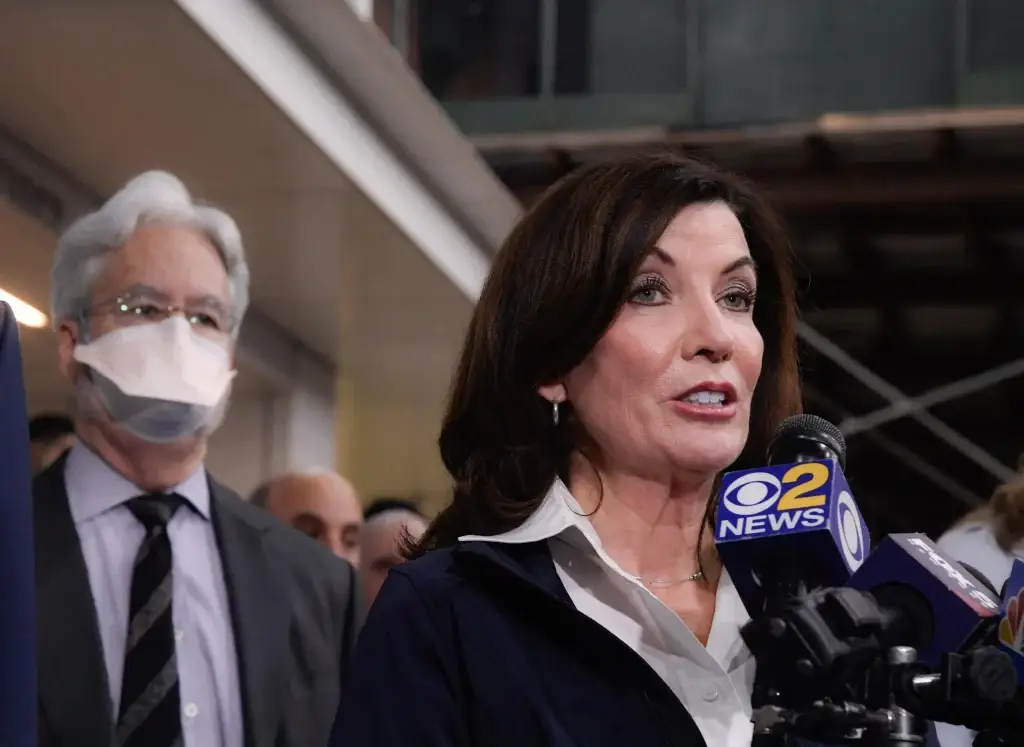
On Thursday, Democratic Governor Kathy Hochul signed Senate Bill S2129B, a piece of legislation that will require energy companies to pay up to $75 billion over 25 years to fund climate change-related projects. While the law is being heralded by proponents as a bold step in combating climate change, critics warn that it could ultimately drive up costs for consumers and set a troubling precedent for future climate-related litigation.
Supporters of the new law claim it will hold energy companies accountable for their role in climate change by imposing massive financial penalties for their historical carbon emissions. State officials have justified the move by arguing that the funds generated from the superfund will be used to improve the state’s “resilience to dangerous climate impacts.” These projects include upgrading drainage systems to mitigate flooding, retrofitting buildings to improve energy efficiency, and creating “green spaces” in urban areas.
However, the legislation is being met with fierce criticism from energy and legal experts who argue that the law could be a backdoor revenue grab that ultimately harms ordinary New Yorkers. O.H. Skinner, the executive director of the Alliance for Consumers, blasted the law as an unjustified attack on energy companies, saying it was little more than a way for the state to raise funds for “pet projects” and progressive initiatives that lack broad political support.
“When you dig beneath the headlines, the story here is very simple: New York State is choosing to punish industries that it doesn’t like, which power everyday activities, and use the money it’s confiscating to fund pet projects and various progressive lifestyle choices that couldn’t get funded by Bernie Sanders and Democrats in Congress,” Skinner said in an interview with The Daily Caller News Foundation. He also argued that the law would burden New Yorkers while doing little to address the carbon emissions of countries like China, which are major contributors to global climate change.
The new law will require energy companies to pay into a superfund based on the amount of carbon dioxide they emitted between 2000 and 2018. State officials will determine the exact contribution of each affected company, with the goal of raising $75 billion over the next quarter-century. While the funds will be used to finance climate change adaptation projects in New York, critics argue that this model will create a heavy financial burden for both the companies involved and, ultimately, consumers.
Ken Girardin, the director of research at the Empire Center, a think tank focused on New York state policy, believes that the law’s provisions will ultimately result in higher prices for consumers. While the energy companies affected by the law will likely fight the implementation of the superfund, Girardin noted that, if the law is fully enforced, the companies would likely pass the costs onto customers through higher prices for electricity, natural gas, and other forms of energy.
“I don’t think that this law will ultimately be implemented, as New York is trying to thread multiple legal needles at once,” Girardin said. “That aside, if these costs were to be levied, it would be entirely within the companies’ rights to recover those costs. They could levy a geographically-focused surcharge… It stands to reason that they would recover their costs by raising prices in New York specifically.”
Already, New York residents face some of the highest energy prices in the country. According to data from the U.S. Energy Information Administration, electricity rates in New York are significantly higher than the national average, with residential, commercial, and industrial consumers all paying premiums compared to most other states. In fact, as of October 2023, the cost of electricity in New York was 50% higher for some sectors than the national average.
READ NEXT: California Pushes New ‘Equitable’ Energy Policy


















IT LOOKS LIKE THIS GOVERNOR,(AS PRETTY AS SHE IS), HAS FOUND ANOTHER WAY TO ENCOURAGE, SALARY PAYING AND JOB AFFORDING, COMPANYS TO MOVE TO CHINA
To stop this theft the oil companies should all stop all gas and oil deliveries to the entire state of New York! When the residents start screaming at their representatives, the demented governor will have to back down! There is no reason why the petroleum companies should have to finance her crazy spending sprees. I would estimate it would take a week in this weather to accomplish the retraction of this foolish rule!
Article I, Section 9, paragraph 3 of the Constitution of the United States, to wit: “No Bill of Attainder or ex post facto Law shall pass.” Ex post facto means after the fact of a crime, which in short means this law according to how it is written, is retroactive from the year 2000, for which has no standing according to our Constitution. I suggest to those who know the law might want to shed light on this “Rule of Law,” and put it to the test.