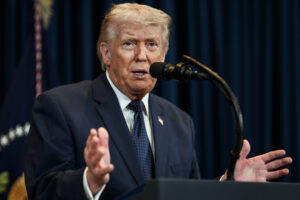

President Donald Trump said he plans to attend oral arguments at the Supreme Court of the United States on Wednesday in a closely watched case that could reshape the interpretation of birthright citizenship.
The case, Trump v. Barbara, will decide whether children born in the United States to individuals in the country unlawfully or to foreign visitors are automatically granted citizenship under the 14th Amendment to the United States Constitution.
Speaking to reporters, Trump said he intended to be present for the arguments and reiterated his long-standing opposition to current interpretations of birthright citizenship. He argued that the 14th Amendment was originally intended to address the status of the formerly enslaved following the Civil War, rather than to apply broadly to all children born on American soil regardless of their parents’ status.
The case follows an executive order Trump signed immediately after returning to office, seeking to end automatic citizenship for children born in the United States to individuals who are in the country unlawfully or temporarily. The policy was quickly challenged in court by immigration advocacy groups, ultimately leading to Supreme Court review.
Birthright citizenship has been a subject of legal and political debate for decades. While the 14th Amendment states that all persons born or naturalized in the United States and “subject to the jurisdiction thereof” are citizens, interpretations of that language differ.
Supporters of the current system argue that longstanding precedent—particularly the 1898 Supreme Court case United States v. Wong Kim Ark—supports broad birthright citizenship, regardless of parents’ immigration status. They contend that changing this interpretation could create legal uncertainty and affect millions of people.
Opponents, including legal scholars, argue that the phrase “subject to the jurisdiction thereof” was historically understood more narrowly and does not necessarily extend to children of individuals who are not lawfully present or who maintain allegiance to another country.
The issue has also drawn attention in broader immigration debates. Estimates from groups such as the Center for Immigration Studies have suggested that a significant number of children are born each year to parents without legal status, complicating matters of immigration enforcement.
The Supreme Court has not directly ruled on the specific question of whether children born to individuals in the country unlawfully are constitutionally guaranteed citizenship, making the current case potentially significant in clarifying the scope of the 14th Amendment.
A decision in Trump v. Barbara could have far-reaching consequences for immigration policy, citizenship law, and future legal interpretations of constitutional language. The Court is expected to issue its ruling later this year.
READ NEXT: PolitiFact Fails: Why PolitiFact Misfired On Birthright Citizenship